When you try to build a platform that solves problems for large enterprises at scale, the platform faces a specific and demanding set of requirements. This post is my attempt to think through this topic — one that's been very much on my mind.
Note: For my definition of "platform," please see the earlier article.
What Environment Are Enterprises Operating In?
When serving enterprise customers as a platform, the requirements they bring can seem irrational at first glance — at least from the perspective of a startup like ours.
But once you understand their position and correctly appreciate their business environment, those requirements often turn out to be highly rational.
So what does the world look like from an enterprise's perspective? Here's an attempt to put their reality into words:
Every day, we handle hundreds of thousands to millions of transactions. Our customers' needs are highly diverse, and our business domain has expanded over decades. To improve customer satisfaction, we utilize numerous systems and databases. Connecting these systems to enhance service quality takes time and effort, but we manage to get there. This combination of proprietary services, proprietary operations, and brand identity is what creates our competitive differentiation and attracts customers.
But we face intense competitive pressure in the market at all times. We must keep launching new features and new business lines to sustain our advantage. Multi-channel expansion is a challenge facing virtually every company — and every time we add a new channel, we often have to rebuild the operational infrastructure we've worked so hard to create.
Meanwhile, the vast amounts of customer data we've accumulated, combined with our increasingly complex internal operations, put us in a constant battle against security risks and cyber threats.
A few key themes emerge from this:
- Massive customer base
- Critical importance of system and database integration
- Multi-vendor environments
- Multi-channel presence
- Unique, proprietary operations
- Intense competition and pressure to change
- Security risk
Requirements for an Enterprise Platform
This business environment translates into requirements for anyone serving enterprises as a platform provider. I believe the must-haves come down to five:
(Five requirements listed here)
Tracing these requirements to their logical conclusion leads to one clear direction: Headless.
That is: a platform that focuses on delivering value at the API and data layer, completely decoupled from the frontend.
Why Headless?
For enterprises, the need to express unique value is far stronger than startups typically imagine.
Take Toyota. With multiple product lines — Toyota, Lexus, and wholly owned Daihatsu — there's obviously no reason for the brand pages to look the same. Dealer atmosphere, website structure, the feel of sitting in the car — every customer touchpoint is deliberately different. This implies that their operational requirements are just as diverse.
At the same time, when it comes to the customer — managing customer identity, purchase history, usage history — they would naturally want a unified view to enable the right kind of engagement.
For businesses that want to serve multiple enterprises (like us), this creates a difficult problem: scalability across companies and operations, while also enabling integration of end customers.
The number of enterprise clients may be countable on your hands — but the operations and customer experiences are essentially infinite. You can't attach a new frontend to every application and expect this to work. That's why going Headless becomes not just attractive, but almost necessary.
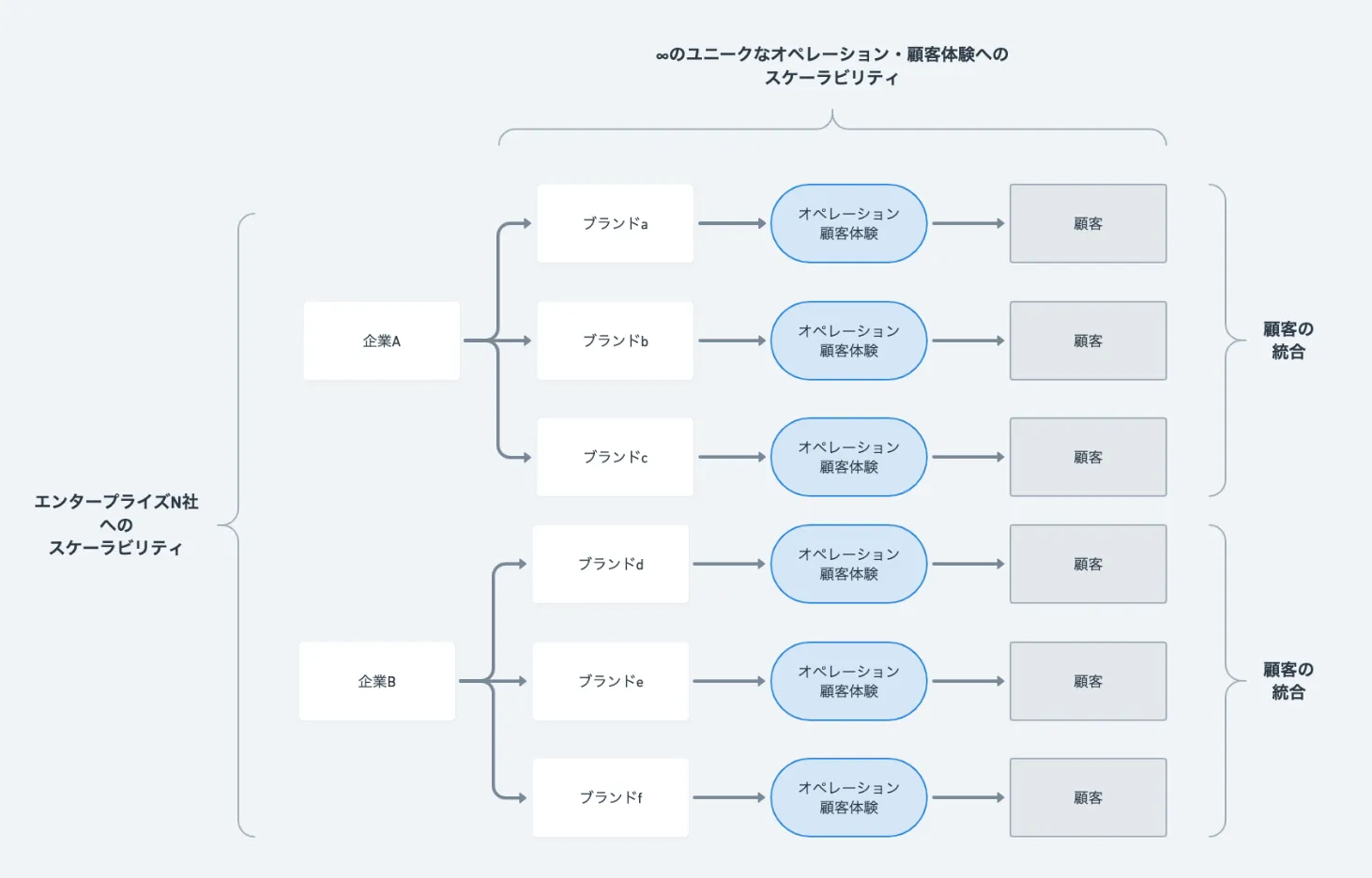
The idea: expose the interfaces (APIs) of each application layer — operations, customer experience, etc. — at appropriate decomposition points. Allow these to be combined selectively to build the structural backbone. Let enterprises freely build their own frontends on top of those APIs. That is the Headless value proposition.
This is how you might actually scale a platform for enterprise customers.
Caveat: Only if enterprises can actually build (or control the building of) their own frontends.
The Rise of Headless Commerce
In the e-commerce space where 10X operates (broadly defined), enterprise-grade solutions had been scarce for a long time — the gap between what Amazon Marketplace or Shopify could offer and what large retailers actually needed had never been properly filled. Shopify launched Shopify Plus to address this gap, but competitors have focused even more squarely on the enterprise category.
Companies like Spryker, Swell, Chord, Shogun, Commercetools, and Cart.com are among those rising rapidly in the category now called Headless Commerce.
Even in just my awareness, there are this many. All API-first, all serving multiple well-known enterprise clients, all supporting diverse customer experiences through a single platform.
None of these players is currently in e-Grocery (online supermarkets), the hardest segment of e-commerce to crack. But five years from now, services like Stailer should be on that list — and we intend to be.
2022 has been 10X's landmark year for taking the first real step toward becoming a platform. The gap between where we are and where we need to be is so large that looking up, I can't see the ceiling — but I see all of it as opportunity.
10X Careers


Comments
Share your thoughts or questions. Comments are published after approval.
Write a comment