The News
On the morning of September 15, 2023, my maternal grandmother passed away.
I was in my home office in Osaka, in the middle of an online meeting.
I missed a LINE message from my mother and learned the news through a text from my wife. I was the speaker at that moment in the meeting, and my mind went blank.
After the meeting ended, I called home.
I talked with my father about logistics — the timing was still undecided, the funeral parlors in Hirosaki (my hometown in Aomori prefecture, in northern Japan) were backed up and nothing was confirmed yet.
Then my mother came on the line. Her voice sounds so much like my grandmother's that something in me gave way, and I started sobbing — a kind of crying I almost never do. My second son, who was resting in the next room with a cold, was startled.
I didn't want to wait for the wake and funeral, still unscheduled. I just wanted to see her face one more time. I flew from Osaka to Hirosaki that day to say goodbye.
She was 91. The cause of death was heart failure, but I was told she went peacefully and without suffering, and I felt some small relief.
The day before, she had apparently been walking around in the hospital ward, fell, and later that morning had a bowel movement that gave her some comfort. Her family was scheduled to visit that afternoon. She passed in the early morning before they arrived.
I was glad she didn't suffer. I was glad her final moments were peaceful.
In her later years, my grandmother struggled with Alzheimer's disease.
I was living far away by then, but the family must have had a hard time. The medication and care facility helped, and she continued to live with some vitality.
COVID had kept me from seeing her for the past three years.
What I'll always regret is that I never got to see her face one last time while she still knew who I was.
But when I saw her in the cool, dim room of the funeral parlor — naturally older than I remembered, yes, but her hair still lustrous — she looked to me like herself, the grandmother I always knew.
There was a stillness about her, as though her soul had already gone somewhere else. She had moved on to wherever it is we go, I thought — and somehow that felt right.
My own grief had already been released in those sobs the day before. Standing with her body, I was able to say goodbye with a kind of quiet peace.
My grandmother had lost her beloved husband nearly 30 years earlier.
After that, she lived alone in a large house — but managed to do so with energy and spirit.
Until her Alzheimer's progressed, she drove herself places, wore beautiful kimonos, practiced tea ceremony and flower arranging, and traveled with friends.
When I was in university in Sendai, she once came to visit and met my then-girlfriend (now wife).
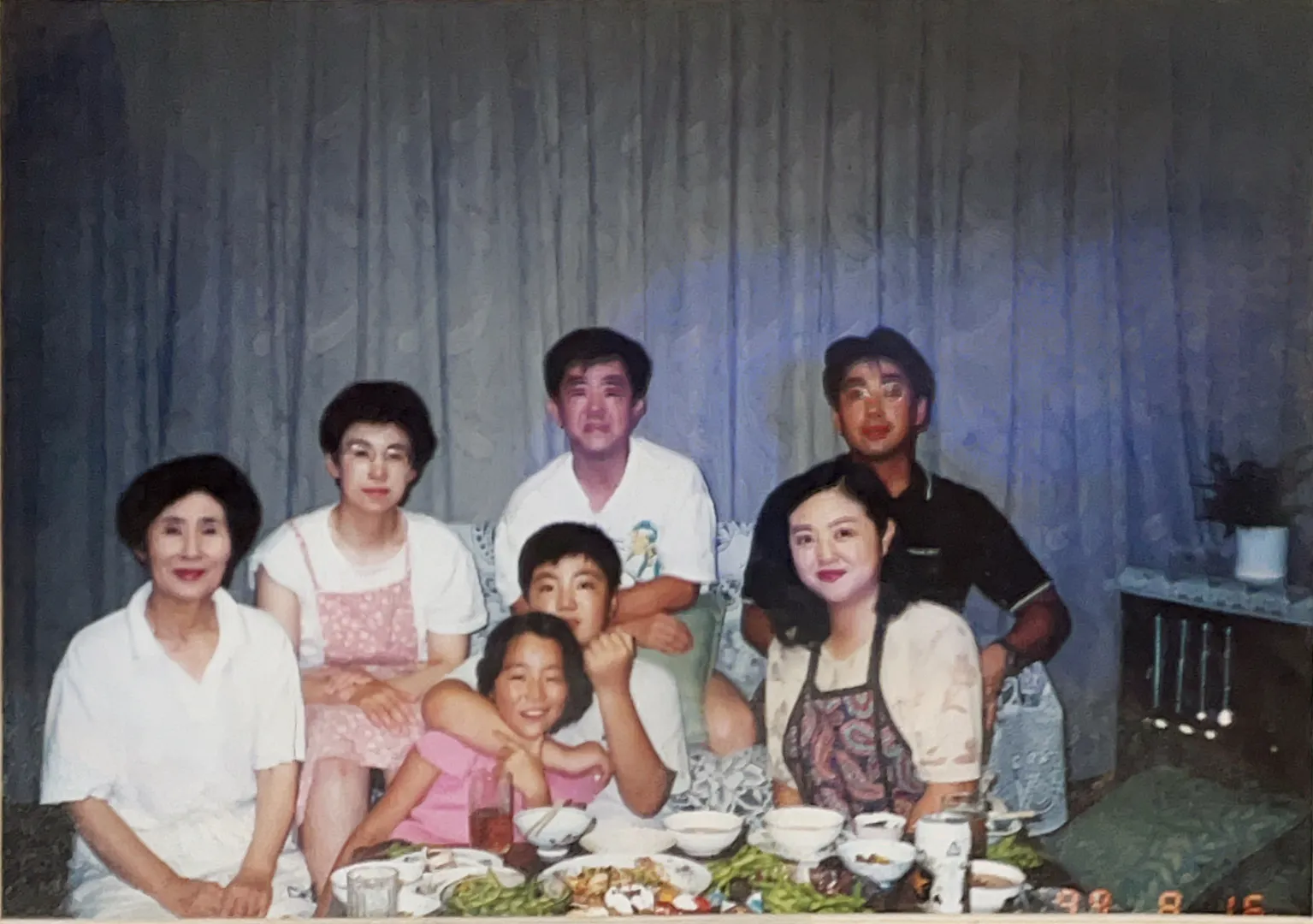
On the evening after we saw her off, I sat down to dinner with my father, mother, wife, and our youngest — who I'd brought with me. My parents told me something: through all the years of living alone, through the Alzheimer's that took so much, what gave my grandmother the will to keep going was me and my younger sister.
Even as the disease stripped away her ability to form new memories, she would ask over and over: "How's Maa-chan (her nickname for me) doing? How's Yoc-chan (my sister)?"
She couldn't hold onto new information — couldn't remember meeting my wife or seeing my children. The kids had to introduce themselves "for the first time" several times.
But she always remembered me. Her memory had frozen somewhere around the time I finished university. That version of me was who she kept with her.
A Memory
I must have been just starting elementary school.
My grandparents took me — just me — on a trip to Disneyland in Tokyo. My memory of the day itself is hazy, but one thing I remember vividly: on the way out, I started whining because I wanted a light-up toy sword.
We looked in one gift shop, couldn't find it. Moved on to another. Then another. We walked through the park as it grew dark, both of them exhausted from a full day. But they never showed a trace of frustration — and when we finally found "the light-up sword" at last, they celebrated with me, as genuinely happy as I was.
She was a gentle grandmother.
She apparently told my mother and uncle about that day many times afterward — never mentioning how tired they must have been, only that finding it together made her truly happy.
When I was in elementary school, around the same age, I got angry about something and "ran away from home."
I don't remember what I was angry about.
It was a child's version of running away — I was just wandering around the park near our house — but my grandmother got in her car and drove around to find me. She caught up with me somewhere along the walking path at Joto Park, as I recall.
She ran to me with a worried face, held me, and gently talked me through whatever it was.
She was also strict about manners and language. When leaving the house: "Itte mairimasu" (a formal way of saying "I'm going out"). When returning: "Tadaima kaerimashita" (a formal way of saying "I'm home"). If you forgot, you got a correction.
She was a retired schoolteacher, and she raised me with those standards.
Our family is a family of teachers — her, my parents, and eventually my younger sister became a teacher too. I alone veered off into a completely different world. She didn't really understand what I was doing, but she cheered me on anyway.
What Remains Between Us
My grandmother had many hobbies. Her house is full of books, kimonos, and dolls she made herself.
The house itself is a kind of possession. I helped sort things when I visited Hirosaki the day before flying home.
But honestly, I don't feel drawn to any of these things.
I'm a realist, and maybe that's why — I can't feel her presence in objects.
Being a realist is also why I think about what actually remains between someone gone and someone still here.
Only memories. Only what happened between her and me.
Objects can outlast a person. But I don't feel any pull to hold onto them.
What I want to hold onto are the real relationships and moments that existed only between her and me.
Because that's the only proof that both of us were ever really there.
Even now, I can still hear her voice clearly, calling me "Maa-chan."






Comments
Share your thoughts or questions. Comments are published after approval.
Write a comment