About a year ago, a friend named Hikaru introduced me to a YouTube channel called 社會学部長 (Shakaibu Bucho). I've been watching every episode since — it's become one of my favorite channels in the "actually serious" category (I admit the non-serious ones still outnumber it).
The channel covers geopolitics and sociology through animations and calm narration. Even though I was terrible at history in school, I find myself breezing through episodes that run 30 minutes or more.
The recent video, "The Most Critical Problem That Would Happen If the US Withdrew from NATO," opens with a conclusion that stopped me cold: "The real problem is Germany getting too powerful" and "NATO was never really about Russia." It then builds that case through the lens of the World Wars and geopolitics.
I wanted to understand this more than just as current events trivia, so I did a bit of research and am writing this to organize my own thinking.
What Changes If the US Leaves NATO
The first thing most people think of is weakened deterrence against Russia.
NATO's backbone is Article 5 — collective defense. An attack on one member is treated as an attack on all. What Russia truly fears is direct confrontation with the United States. Without the US, that clause loses most of its teeth.
There are also very concrete problems. European NATO members import 58% of their major weapons from the US, and the F-35 — Europe's frontline fighter — depends on American software, communications, and maintenance. Without US support, it's essentially non-operational.
So why does Germany pose a bigger problem than Russia?
NATO's Real Purpose
Photo by Waldemar Brandt on Unsplash
There's a famous line from Lord Ismay, NATO's first Secretary General: "Keep the Russians out, the Americans in, and the Germans down."
The EU's combined GDP is roughly ten times that of Russia ($19.5 trillion vs. roughly $2 trillion). The video argues flat-out that "even without the US, it's only a matter of time before Europe catches up to Russia militarily." And that's plausible — Europe's defense spending as a share of GDP has historically been lower than Russia's, so there's real fiscal headroom to close the gap over time.
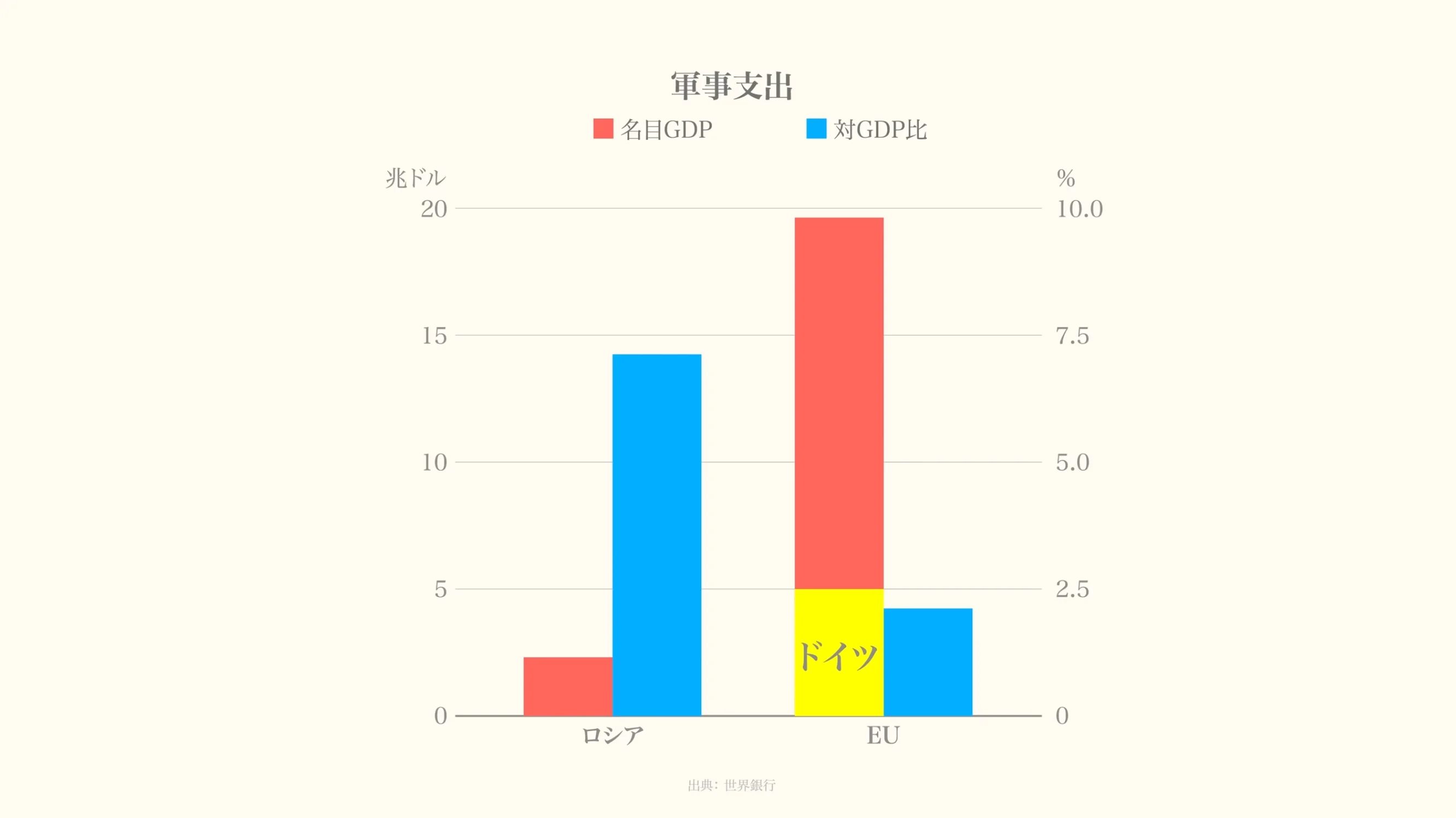
But that economic capacity exists and Europe still hasn't built up its military. So the core problem must lie somewhere else.
The real issue is a command vacuum — the absence of a credible commander. NATO's Supreme Allied Commander Europe (SACEUR) has always been an American. The reason: the US, as a powerful outside actor, has served as a kind of referee keeping frequently competing European nations in line.
The German Question
This video introduced me to the concept of the "German Question" for the first time.
Germany sits near the center of Europe, geographically surrounded on all sides — a position that naturally breeds anxiety.
- That anxiety drives Germany toward rearmament
- Which in turn stokes suspicion among its neighbors (France, the UK, Russia)
- Which drives them toward rearmament
That vicious cycle is considered one of the underlying causes of two World Wars in the twentieth century.
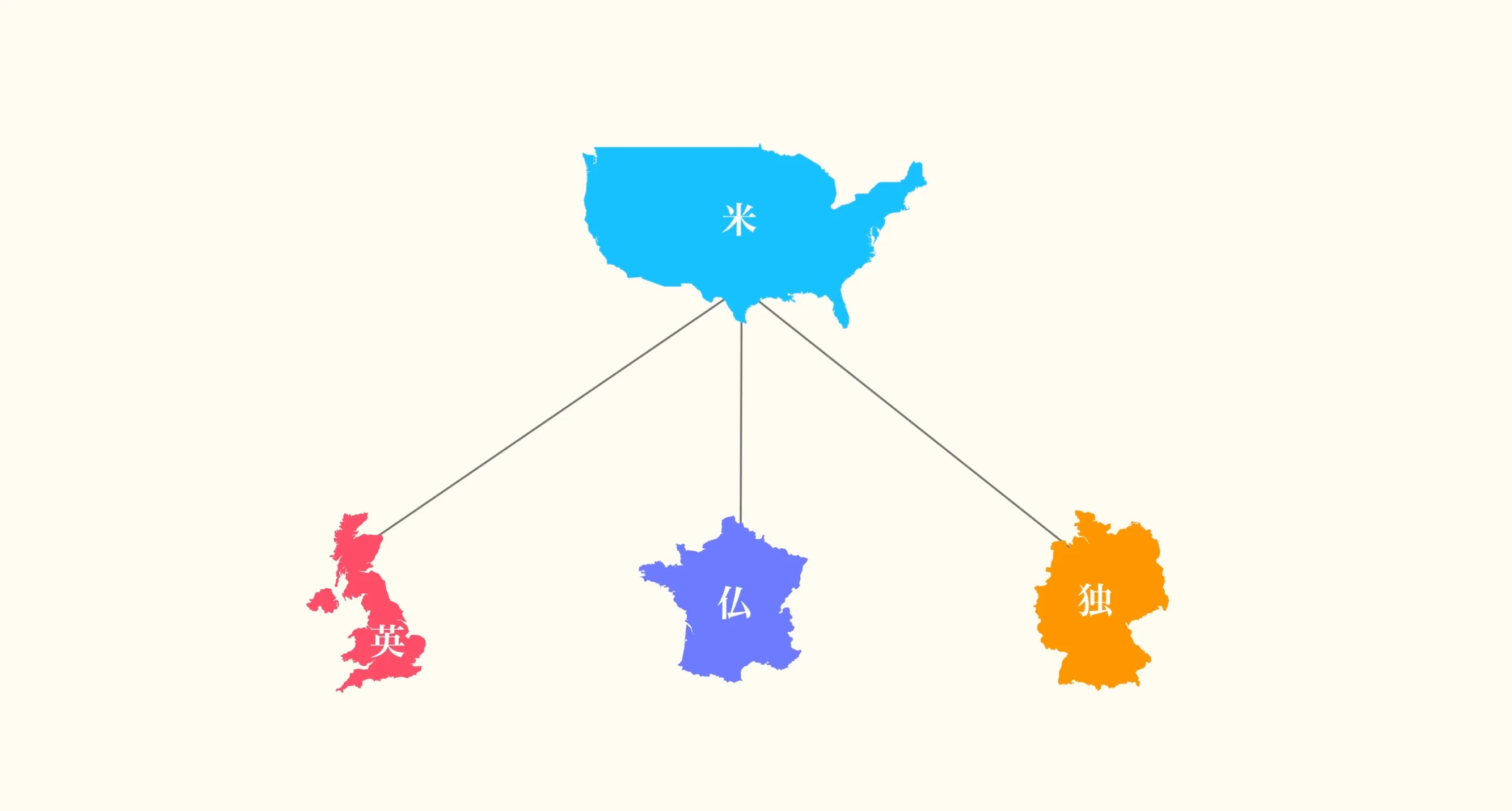
NATO was, in structural terms, the answer to the German Question. It allowed Germany to maintain military power while placing the "steering wheel" in American hands. France and other neighbors could feel secure, and Germany's own security was guaranteed.
Europe After America Leaves
If the US withdraws, that balance collapses. Germany would be forced to rearm for self-defense, and mutual suspicion between Germany, France, and the UK would almost certainly follow.
Old embers suppressed by American pressure — the ethnic tensions of the Balkans, the Greece-Turkey rivalry — could reignite as well.
There's a brutally cold-eyed conclusion lurking here: today's peaceful Europe is a historical anomaly, and a US exit might simply return Europe to what it looked like eighty years ago. That may be where the world is heading.
You Can't Fight Structure
The NATO story makes it painfully clear how fragile any order built on temporary arrangements really is.
Europe has no historical precedent of being united under a single power. Tension and deterrence have always been the default state, driven almost entirely by geopolitical structure. That structure, in the end, cannot be wished away — another cold, bloodless fact.
One small footnote: this video turns out to be a sponsored piece for an app called Speak, which only becomes apparent right at the end. The pivot was so forced it genuinely surprised me.
If a channel of this quality can get away with an ending like that, surely this blog deserves the same latitude.
PS. Sengoku
When I first encountered the German Question, the first thing that came to mind wasn't European history — it was the Nobunaga Encirclement (Nobunaga Hōimō), the coalition of lords led by the Asakura and Asai clans that formed around Oda Nobunaga as he rose through Japan's Warring States period.
This episode is often framed as "a betrayal by Asai Nagamasa, a man Nobunaga treated like a younger brother." But I suspect the real explanation is structural: Nobunaga's strongholds in Gifu and Kyoto were geographically prone to encirclement whenever he moved to expand — much the same dynamic as Germany.
Almost all of my knowledge of Japan's Sengoku period comes from manga. The Sengoku series is a bible I reread at least once a year. For the past decade I've been looking for the equivalent in world history — still searching.
Comments
Share your thoughts or questions. Comments are published after approval.
Write a comment