In 2026, the way we work in software development has changed completely, and I now hardly ever type code into an editor myself. The center of the job has shifted to deciding what to build, writing down the standard for what counts as good, and checking what comes back from coding agents.
Google has announced that AI writes 75% of its new code, with engineers approving it. Some teams now call development where humans neither write nor review code a "software factory."
(A side note: the first organization to call a software group a "factory" seems to have been Hitachi, in 1969. Back then, the word assumed a place where many people standardized how software got made, while today's factory aims to be a place with no people in it. The word is the same, but the worldview behind it has become very different.)
Like software, the music industry saw both production cost and delivery cost drop to nearly zero, and it got there first. Will software follow the same path as music?
What Happened in Music
In 1999, Napster launched, and songs started circulating for free. In 2003, the iTunes Store made songs 99 cents each, and after Spotify launched in 2008, all-you-can-listen subscriptions spread. On top of that, with a distribution service like DistroKid, anyone can send a song made at home out to the whole world.
Amid this upheaval in the market, global recorded music revenue fell through the 2000s and bottomed out at $13.1 billion in 2014. It then grew for 11 straight years, reaching $31.7 billion in 2025. About 70% of that is streaming.
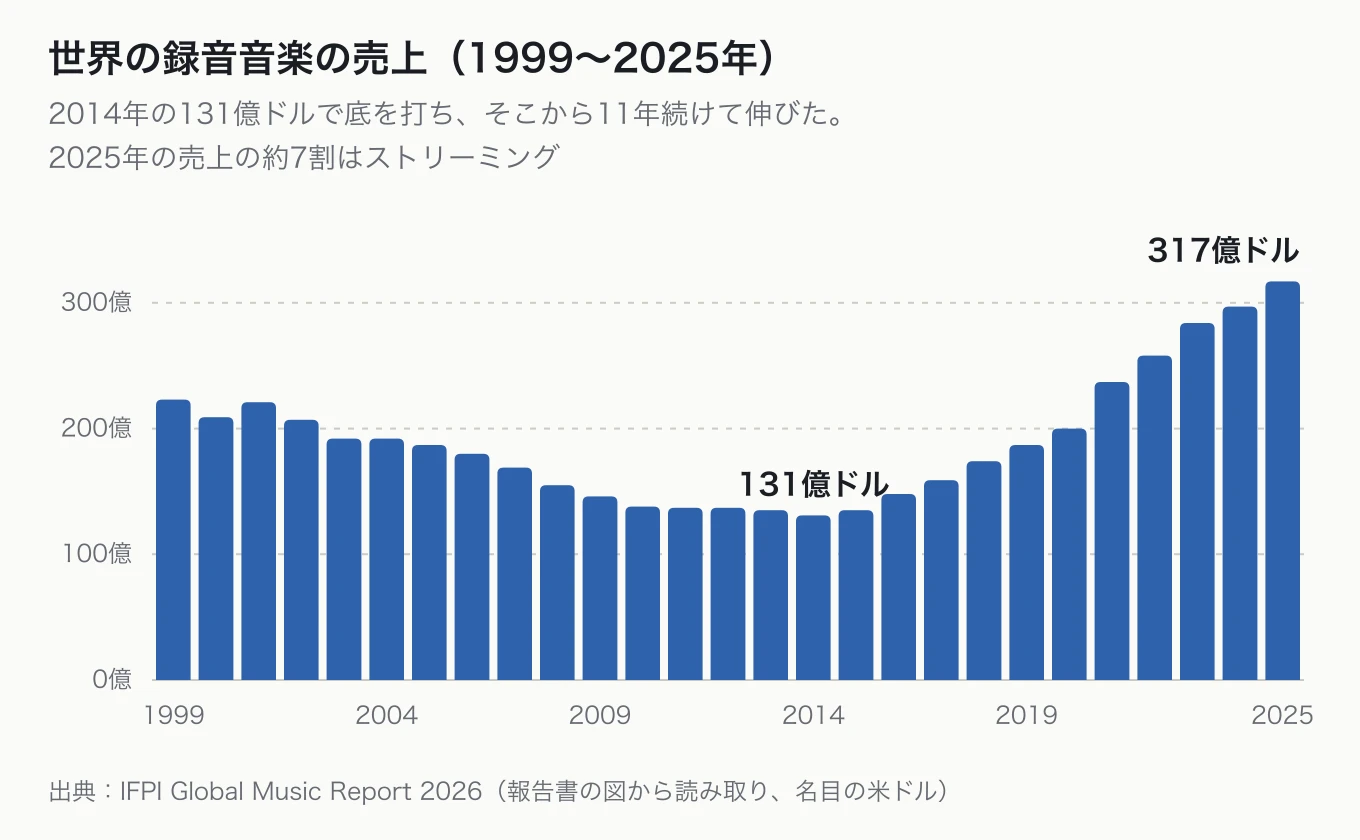
For a while it looked as if the market might disappear. Instead, the way of earning swapped from "sell one CD" to "let people listen for a monthly fee," and you could say a new market was opened up as well.
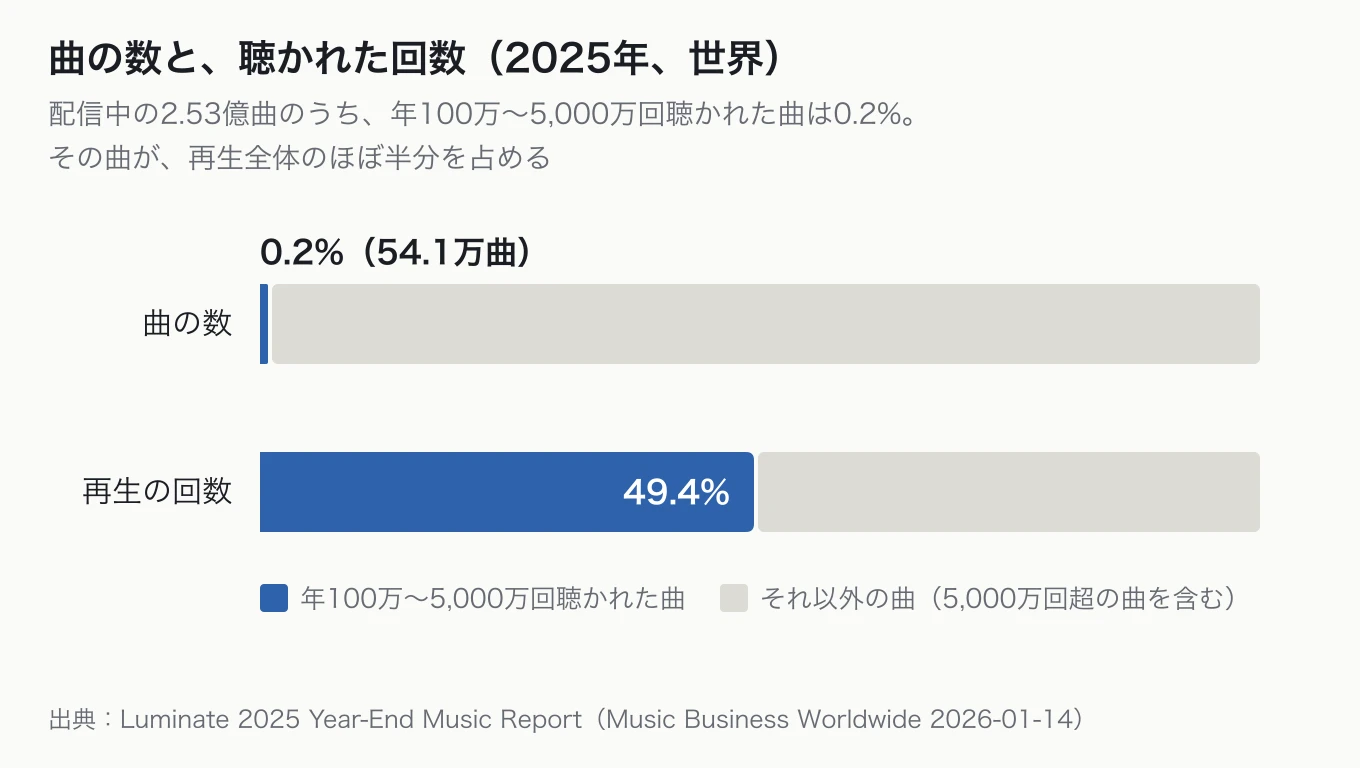
At the same time, songs flooded the world, and their value became concentrated in a few. 106,000 new tracks reach streaming services every day, and 88% of the 253 million tracks on offer are played fewer than 1,000 times a year. The 0.2% of tracks played between 1 million and 50 million times a year account for 49.4% of all plays (according to Luminate).
Through this disruption, "what customers are willing to pay for" survived in three places.
- The place where people listen: Spotify has 788 million monthly users.
- Old songs whose quality is settled: In 2024, 73.3% of US music consumption was catalog, meaning tracks more than 18 months past release.
- Live shows that can't be copied: Live Nation's 2025 revenue was $25.2 billion.
Is the Same Thing Happening in Software?
| What happened in music | Signs in software |
|---|---|
| Works flood in and most go unheard | New apps on the App Store doubled in the first half of 2026, while downloads grew just 2% |
| People gather where listening happens | ChatGPT runs apps inside a conversation, and the number of components callable from AI has passed 10,000 |
| Songs whose quality is settled (catalog) become assets | One company has bought and held more than 1,000 old business software companies |
| Earning from live shows that can't be copied | Job postings for technical roles that go into the customer's site and own the outcome rose more than 1,000% year over year |
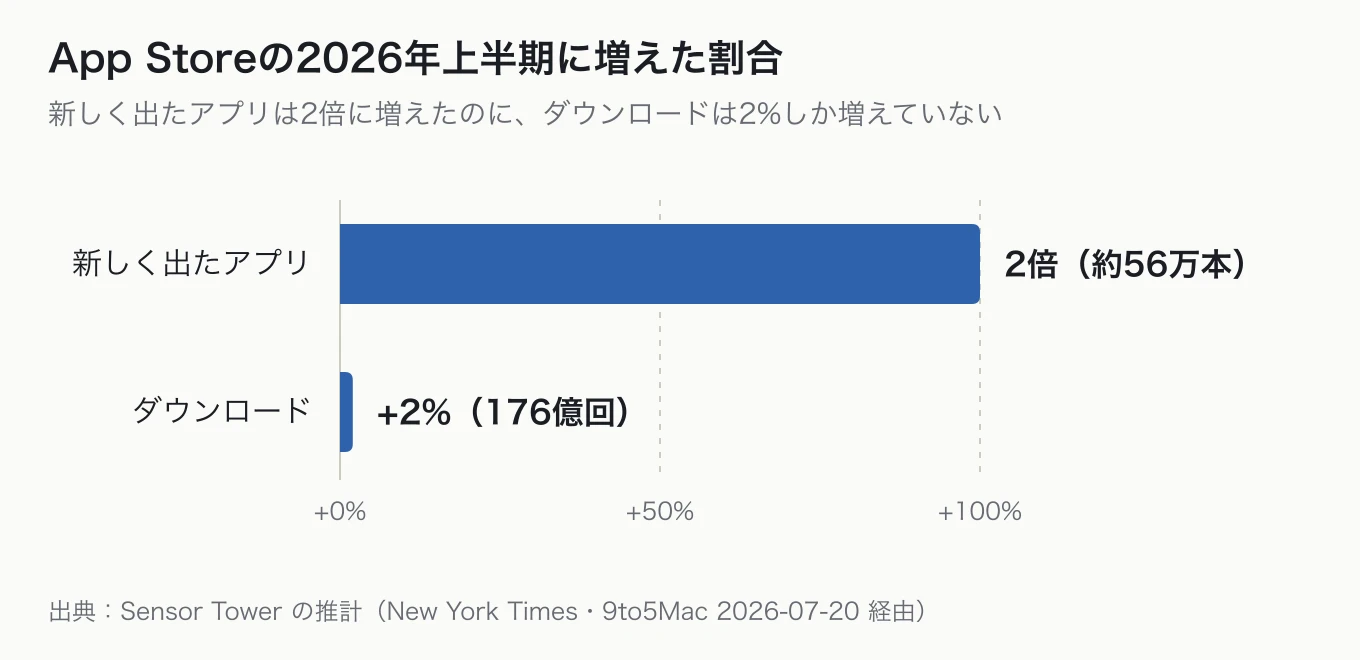
As AI has sharply cut the cost of making software, software is flooding the market just like music. The number of new apps on the App Store doubled in the first half of 2026 to about 560,000, closing in on the roughly 600,000 for all of 2025. Meanwhile, growth in total downloads was only 2% (according to Sensor Tower).
Aggregation of software is also starting to happen, and the place where it happens is becoming AI itself. ChatGPT now lets you run apps inside a conversation, and the components callable from AI (MCP servers) have passed 10,000. The race to consolidate the point of contact with users on the premise of aggregation, as with Meta's Muse and Anthropic's Claude Duet, is intensifying.
What I wrote earlier in "AI Agents Are Competing on "Where" They Live" is now happening on the software side too. That said, a system like Spotify's, which shares revenue according to how much something was listened to, barely exists in the software world yet.
The software equivalent of an "asset whose quality is settled" would be business systems that have been running for a long time. A music catalog is not just old songs, but songs whose quality has been settled. The more new songs flood in, the more that settled quality becomes a value that's hard to replace, I think. Software is a world that prizes functional value, so I'm only half convinced the same thing will happen there. Still, I understand firsthand that the value of "a company that runs trusted business software that has been in operation for years" is not something you can easily replace.
Companies like Constellation Software, which has bought and held more than 1,000 old business software companies, seem to be betting on that value. The US federal government also spends about 80% of its IT budget on operating and maintaining the systems it already has.
Now, the third pillar, live shows. Even when recordings become free, people pay a lot for live shows because they find value in the exhilaration, the experience, and the once-in-a-lifetime rarity that can only be found there.
Translated to software, once code can be copied without limit, what customers want is less the code than the "result" of the code doing work in their own setting, in other words, the outcome itself. Every company has different operations, different data, and different habits among its users. The work of getting inside that and fitting to it can't be copied the way a recording can.
The role that carries this work, and is drawing unusual expectations, is probably the Forward Deployed Engineer (FDE).
OpenAI describes this role as someone who embeds in the customer's team and owns everything from prototype to stable production. According to Lightcast, job postings for this role from January to August 2026 rose more than 1,000% over the same period a year earlier.
Now, at the start of 2026, a software stock index fell 25% in six weeks. Could this be the equivalent of 1999 in music?
Where Software Differs from Music
A song is finished the moment it's released, and a 50-year-old song still sounds the same today. With software, the work begins after release, and the responsibility to keep operating it remains. The EU generally requires makers to provide security updates for at least five years, an obligation that music doesn't have.
In "The Role of Specs in the Claude Code Era," I wrote that in B2B, whether you can say "that's the spec" with confidence shapes the trust you have with customers. This responsibility remains no matter how much the effort of making things disappears.
One more thing: the only places where I could compare numbers for both music and software were consumer worlds like the App Store and Spotify. For the change happening in business software, about all you can see from the outside is the number of job postings.
Since 2020, 10X has supported the online grocery services of many major supermarkets on a platform called "Stailer." As I wrote in "The Hidden Tax of Being a Platform," if Stailer goes down, every partner's online grocery service goes down with it. Our fees are also tied to our partners' results, so what we sell is less code than the outcome itself: online grocery services that run every day and partners' businesses that grow. I think that, before long, all software will probably be expected to move toward this kind of "outcome-linked pricing."
Recordings Become Free, and Live and Catalog Remain
I think the value of the software "recording," that is, "development," will fall the way it did in music. Works will flood in, most will go unused, and usage will concentrate in a few places.
If software follows the same path as music, the places where its value shows up should also consolidate into three. Owning the place where software is used. Things whose quality is settled (catalog). And running it in the field and owning the outcome (live).
The biggest difference is that in software, no matter how much of a "settled asset" something is, it means nothing unless it ends up running and producing outcomes. Software's reputation is the history of someone keeping it running and building trust over time. And it is still people who judge this trust. Trust takes a long time to build, and it can crumble all too easily at the slightest trigger.
I think that once the effort of building disappears, the work left for makers lies beyond continuing to take on this responsibility of operation: "building trust between people."
References
- Google: Cloud Next '26: Momentum and innovation at Google scale
- StrongDM: Software Factories And The Agentic Moment
- Aaen, Bøtcher, Mathiassen: The Software Factory: Contributions and Illusions (1997)
- Michael A. Cusumano: Japan's Software Factories (Oxford University Press, 1991)
- USA TODAY: 25 Years Since Napster Launched (reprinted by Yahoo!)
- Apple: Launch of the iTunes Music Store (2003)
- Spotify: Spotify Timeline
- IFPI: Global Music Report 2026
- IFPI: Global Music Report 2026 – State of the Industry (PDF, figures in the charts)
- Music Business Worldwide: Key Takeaways from IFPI's Global Music Report 2026
- Music Business Worldwide: A Quarter of a Billion Tracks on Streaming Services (Luminate)
- Music Business Worldwide: Global Audio Streams in 2024 (Luminate)
- Music Business Worldwide: Spotify's Q3 2026
- Live Nation: Full-Year 2025 Results
- 9to5Mac: New Apps on the App Store (Sensor Tower)
- OpenAI: Introducing apps in ChatGPT
- Anthropic: Donating MCP and Establishing the Agentic AI Foundation
- GAO: Federal Government's Legacy Systems (GAO-25-107795)
- Constellation Software: Official Website
- OpenAI: Forward Deployed Engineer Job Posting
- Fortune: Growth in Forward Deployed Engineer Job Postings (2026)
- The Batch: Claude Cowork Plugins and the Software Stock Selloff (2026)
- EU Cyber Resilience Act, Chapter 2 (reprinted)
Comments
Share your thoughts or questions. Comments are published after approval.
Write a comment