In January 2022, I'm leaving Tokyo — the city I've called home for about ten years — and relocating to Osaka. We're moving our family base completely, and starting fresh from scratch.
Work-wise, both my partner and I will be primarily remote, with trips to the Tokyo office or various other locations once or twice a week.
This was a major decision for me personally, for my family, and for our careers. I want to write down what led us here.
A Temporary Relocation and Its Aftermath
Back in August 2021, COVID cases in Tokyo were hitting record highs every day. To protect our children, we temporarily relocated to Aomori (my hometown in northern Japan). The full story is covered in a previous post — this one is its sequel.
That move lasted only a month before we returned to Tokyo, even as cases continued to surge. The reason was my parents. They're retired and living at a relaxed pace, so having the four of us suddenly descend on them put a significant strain on their daily lives. After some honest conversations, we decided to head back to Tokyo. As a son, it was a humbling reminder to let go of any assumption that I could simply lean on my parents or childhood home.
What We Learned as a Family
Though the Aomori experiment was brief, it gave our family something profound: a shift in our values.
The biggest revelation was recognizing how important "physical and psychological breathing room" is for children — space where they can be themselves without worrying about others.
City life in Tokyo meant:
- Always being mindful of the people around you
- Keeping quiet in the apartment so the downstairs neighbors wouldn't complain (this had become a serious source of stress for our whole family, especially during COVID when everyone was home)
- Parks that were packed and hard to enjoy freely
- Nature that was far away and required special outings
In Aomori, it was the opposite. There were fewer people, the environment was open, and I saw expressions on my kids' faces I had never seen before.
I grew up in the countryside before moving to Tokyo, and I had adapted without really noticing the tension. I had also kept defaulting to Tokyo simply because "that's where the work is" — or more accurately, the idea of living elsewhere had never even crossed my mind.
Aomori made me sharply aware of how the environment shapes children's wellbeing — and how I had been closing off possibilities for them out of my own convenience.
Finding a New Home Base
When we returned to Tokyo in September 2021, my partner and I officially kicked off a "find our next home base" project.
Drawing on what we had learned in Aomori, we outlined six criteria — prioritizing the first four based on what we wanted for our children:
The "6 Criteria" for Our New Home
After visiting areas and weighing options, we narrowed it down to two choices: a standalone house in suburban Greater Tokyo, or somewhere in the Hokusetsu area of Osaka (the residential neighborhoods north of the city). We ended up focusing on the latter. Since I traveled to Osaka frequently for work, I tied those trips to house-hunting visits — more trips than I can count.
Information-gathering was greatly helped by Twitter (now X). When it came to things like researching local schools, it was hard to find reliable information anywhere else. People who responded to my posts there were genuinely helpful — thank you.
Why We Chose Osaka
Even with six criteria and two options on the table, the decision to go to Osaka came relatively quickly. Within one month of starting the search we had settled on Osaka, and within two months we had found a place and signed the purchase contract.
The speed was possible because my partner and I shared a clear priority: put the children's environment first. We agreed early on that it was our job to make this choice the right one, rather than wait for a clear-cut winner on every point. That alignment made all the difference.
It also helped that Osaka is my partner's hometown and a city the kids already had some familiarity with.
Life Going Forward
In early 2022, my partner and the kids moved to Osaka ahead of me. The children are saying goodbye to their Tokyo life and longtime friends, and you can see them quietly working through mixed feelings. Watching them adapt and process things, I sometimes feel a lump in my throat. For now, I want to focus on supporting their hearts and building a real sense of home.
On the work side, our new place has more rooms than our Tokyo apartment, so we'll each have a proper space for remote work.
(Side note: the land price difference compared to central Tokyo was staggering. The same budget goes dramatically further in quality here.)
Our new home is within 20 minutes of both Itami Airport and Shin-Osaka Station. Itami to Tokyo is about 90 minutes door-to-door. We'll both need to make Tokyo trips regularly, but that feels manageable.
There will definitely be a chaotic adjustment period. Even so, I want to make this decision one we can look back on with pride — I want our family to find plenty of joy in our new everyday life.
This choice is ours alone. I'm not trying to tell anyone what's right for them. But if someone out there is facing a similar crossroads, I hope this is useful.
And if any readers are already based in the Kansai region — please be our friends. We'd love to get to know you.
PS: What This Taught Me About Work at 10X
This is a bit of a tangent, so I'll add it at the end. The temporary relocation to Aomori gave me an extremely important insight about my work at 10X.
10X builds a service called Stailer — a platform that connects retailers with their customers. We need to continually understand the real experience of end users. Our guiding principle of "start from one person's critical issue" is our way of saying: the strongest position is to be a heavy user of your own product.
But here's the problem: Stailer's retail partners are already spread across Japan, far beyond Tokyo.
For a team based in Tokyo, it is essentially impossible to truly understand the "critical issues" of end users of services operating in other parts of the country. I had felt a vague unease about this for a while, but the Aomori move made it concrete and undeniable.
Living in Aomori, I became a heavy user of Yakuodo's "P!ck and" service — a partner operating in the Tohoku region. And issues that were invisible from a distance suddenly became very clear.
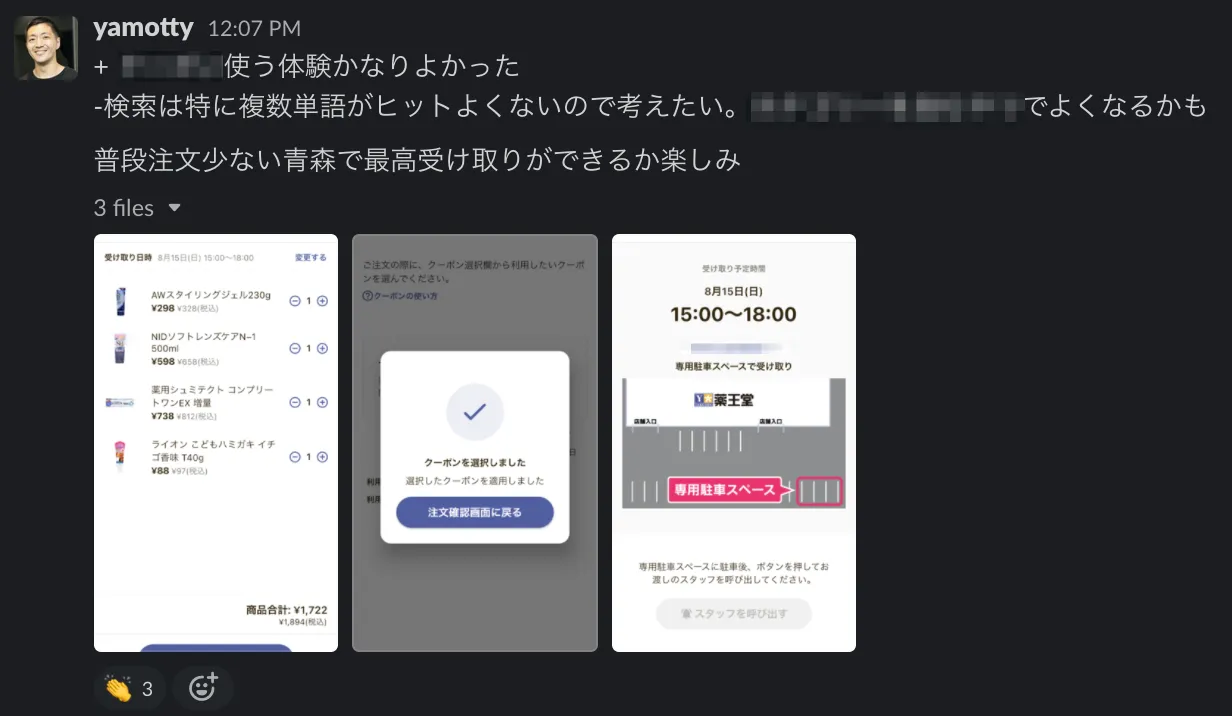
This experience sparked an important question inside 10X: how do we help our services achieve PMF after launch, and then grow? Through 2021, I channeled those learnings into active projects I led directly. And ultimately, they contributed to the shift to a matrix organization that I announced in "10X and Me — 2021."
At the same time, as a management team, we recognized a clear risk: having all our product builders concentrated in Tokyo, living similar lives in a similar environment, creates a kind of uniformity that is itself a liability.
Our team is exceptionally sharp and analytical. And yet there was a real, visible gap in our ability to correctly understand the "context" behind our users' lives.
10X's mission is to support the everyday lives of ordinary people across Japan. For that, diversity of perspective among the people building the product is not optional — it's essential.
This thinking ultimately led to what we formalized as 10X Workstyle.
Diversity of members, diversity of lifestyles, diversity of perspectives — all of it connects to the Stailer business. That intent is built into 10X Workstyle as a policy.
The goal is to protect the conditions for the business to move correctly and quickly, while giving each person the foundation to make their own life choices the right ones. That's one of 10X's organizational challenges. We'd love to build this environment together — and to find people who want to take on the Stailer challenge on top of it.


Comments
Share your thoughts or questions. Comments are published after approval.
Write a comment