Partway through my previous post, Body Control Through Extension and Rotation, I wrote that I still hadn't found the right words for how to pass this feeling on to the kids.
Over the next few weeks, as my eldest son, who had been in a bit of a slump, and I worked side by side on his hitting, I also got better at putting things into words. I'd find materials and videos that looked worth learning from, try the movement on my own body first, put the underlying principle into words in my own terms, and only then pass it on to him. We'd try it together, film it, and give each other feedback. I kept repeating this cycle.
When the words didn't get through, it usually meant either my own understanding or how well I'd put it into words was still shallow. After rephrasing things again and again, only the explanations that actually got through to him were left standing.
I checked the coaching approach that came out of this against the head coach's own thinking and pulled it together into a single page for the team's hitting instruction. This post is based on that memo.
It covers a single yardstick for defining a good swing, the mechanics of how it's the hips and chest, not the waist, that rotate, and the order I use to watch a kid's swing. I've written it so it stands on its own even if you haven't read the previous post.
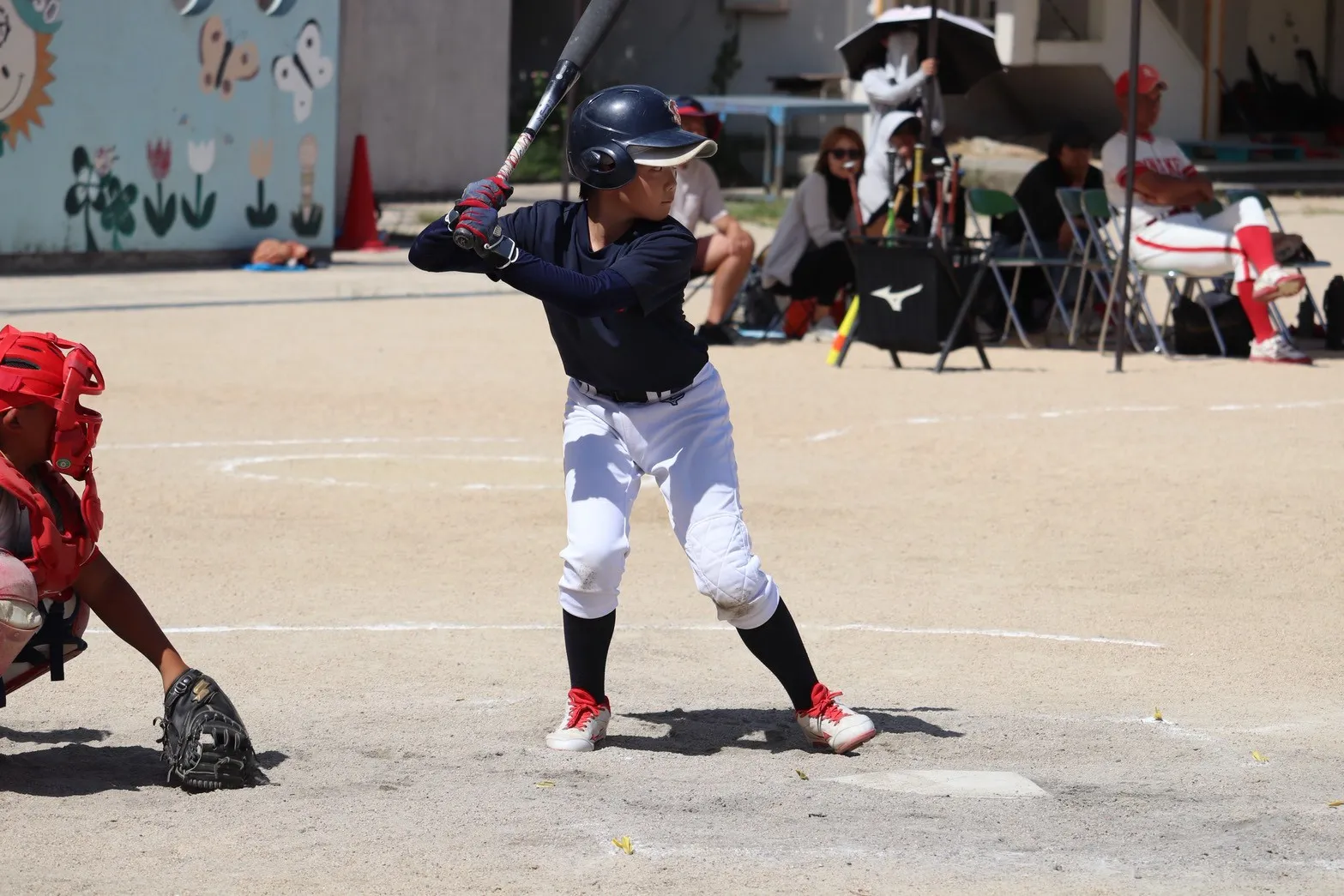
Hitting splits into two parts: the body control behind a good swing, and the timing adjustments that match the pitcher's ball. This post deals mainly with the former.
Without a good swing, even perfect timing won't produce a well-hit ball. I believe that at this age, building a foundation for the future matters more than the result in front of you right now.
A Single Yardstick for a Good Swing
First, I put the goals of our coaching into words as follows.
- Share a common understanding of what good hitting looks like
- Hit using the body's basic structure
- Be able to explain it to kids simply enough, yet thoroughly enough
- Be able to coach each kid's individual quirks as a deviation from that form
Without aligning on these four, we'd end up searching for new words from scratch every time we noticed a different kid's quirk. With a single form to refer to, we can explain things as a deviation from it instead.
The foundation for all four is a single standard that captures that first point, the shared understanding, in one line. I settled on: a swing that maximizes impulse.
Impulse is the total of how hard you push and how long you push for. Force changes moment to moment, so strictly speaking it's average force multiplied by time. Here I'll write it as F×t.
That said, the t in this post isn't physical time in the strict sense. I'm using it to mean the duration the bat faces the ball's path, where a longer duration raises the odds of contact. F is the force at the moment of contact, in other words, how hard the ball gets hit.
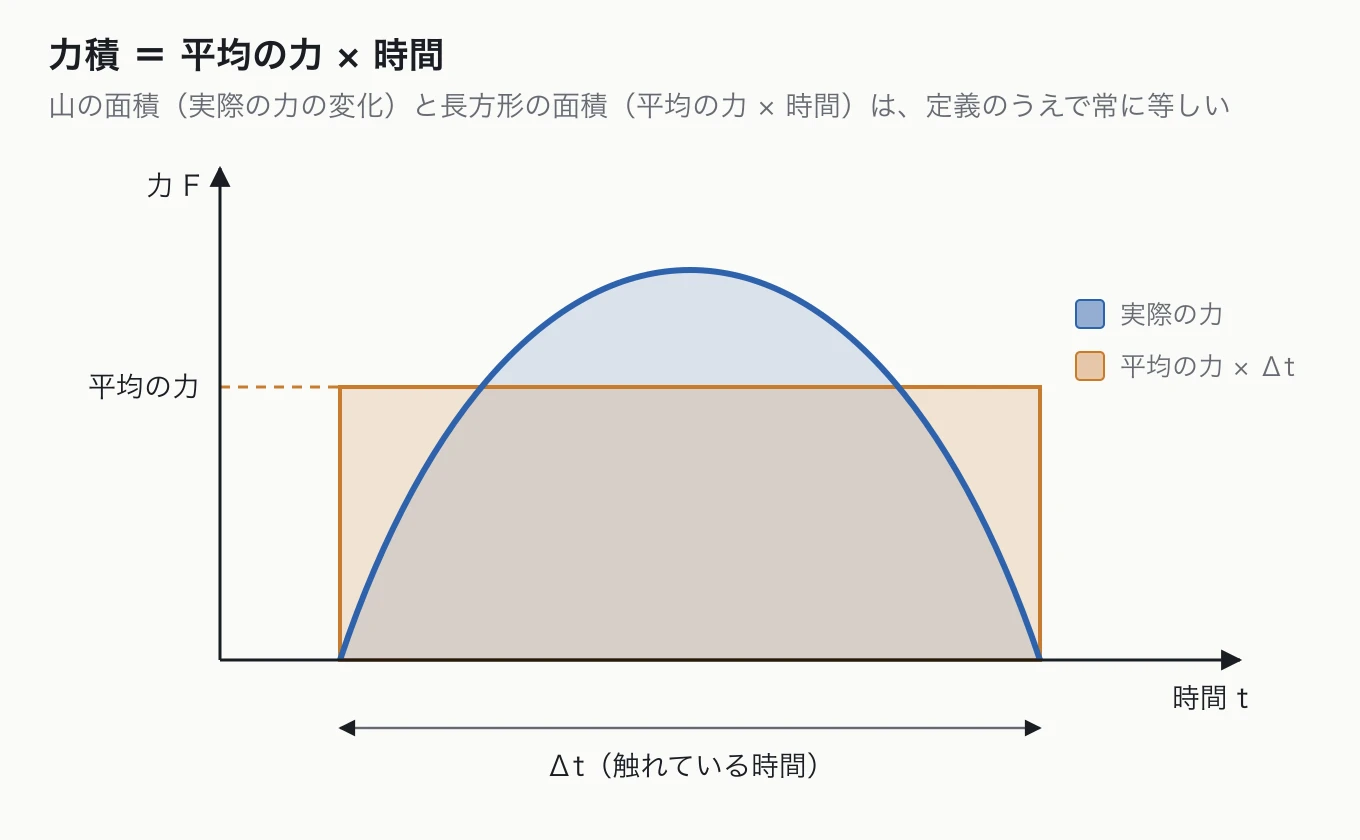
A diagram I redrew myself from the textbook definition in physics. The Δt in the figure is the actual contact time, which is different from the t used in the text.
Strictly speaking, the time the bat and ball are actually in contact is on the order of a thousandth of a second, not something a batter can control. What I'm borrowing here is just the form of multiplying force by time.
I made it a multiplication because if either side hits zero, so does the ball. If your head moves while you're swinging hard, you gain F but lose t. What I like about this standard is that it lets us talk about the trade-off between t and F on a single yardstick.
With a long t, you can still make contact even if you're a bit jammed (swinging slightly late). With a large F, the ball still carries even if you're slightly off the barrel. Because you no longer need perfect timing, I believe the batter is freed up to pay attention to the pitcher and the situation instead.
Raising the Odds of Contact (t)
Lengthening t breaks down into two broad things. The first is extending the time the batter can keep the ball in a stable sightline. The second is extending the time the bat faces the ball's path.
What you want to avoid is the head moving forward, back, up, or down mid-swing, and casting (the so-called "door swing"). Casting happens when the elbow straightens too early and the bat swings in a wide arc from outside, like a door swinging open.
With casting, the bat's path traces a large circle centered on the body, so it meets the ball's path at a single point rather than along a line. Because the overlap is just a point, the slightest timing error makes you miss the barrel.
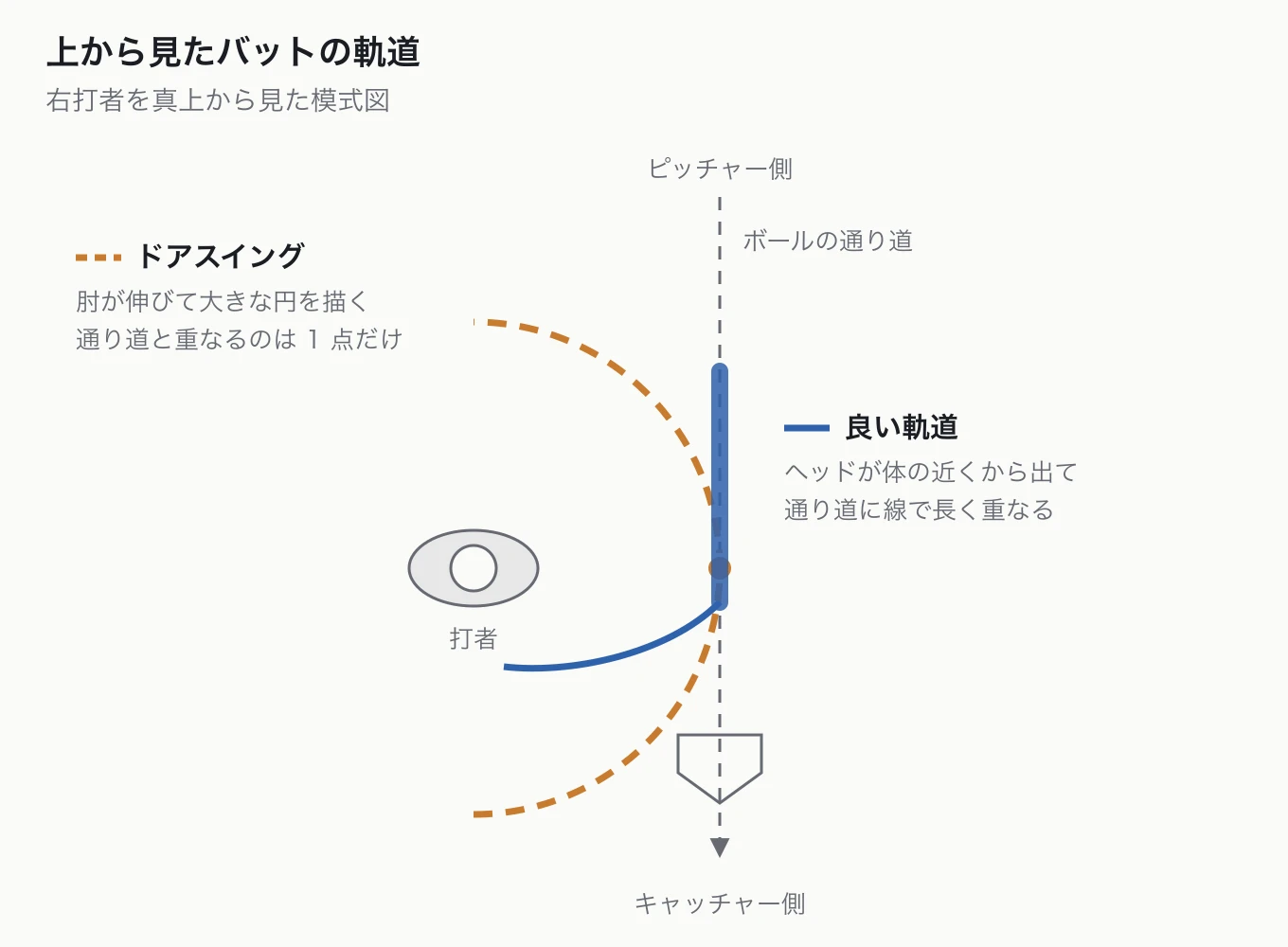
A schematic diagram, not an actual measured path.
Conversely, if the bat head comes out close to the body, the overlap with the ball's path gains some width. Contact stays possible even if you're a bit jammed, or even if you lunge out ahead of the pitch (committing too early).
The worse the timing, the more likely panic brings on head movement and casting. Timing itself is outside the scope of this post. Even so, I put body control first because a swing with a long t is what gives you room to absorb a timing error.
Hitting the Ball Harder (F)
Increasing F requires delivering the force of pushing into the ground and the twisting of the body to the bat without loss. This picks up where the previous post's "push, brake, rotate" left off.
We teach this as three basic movements: hip rotation, rib cage rotation, and forearm supination. Pushing and braking both fall under hip rotation; rotating falls under rib cage rotation. Forearm supination is the final handoff to the bat, something I didn't cover last time.
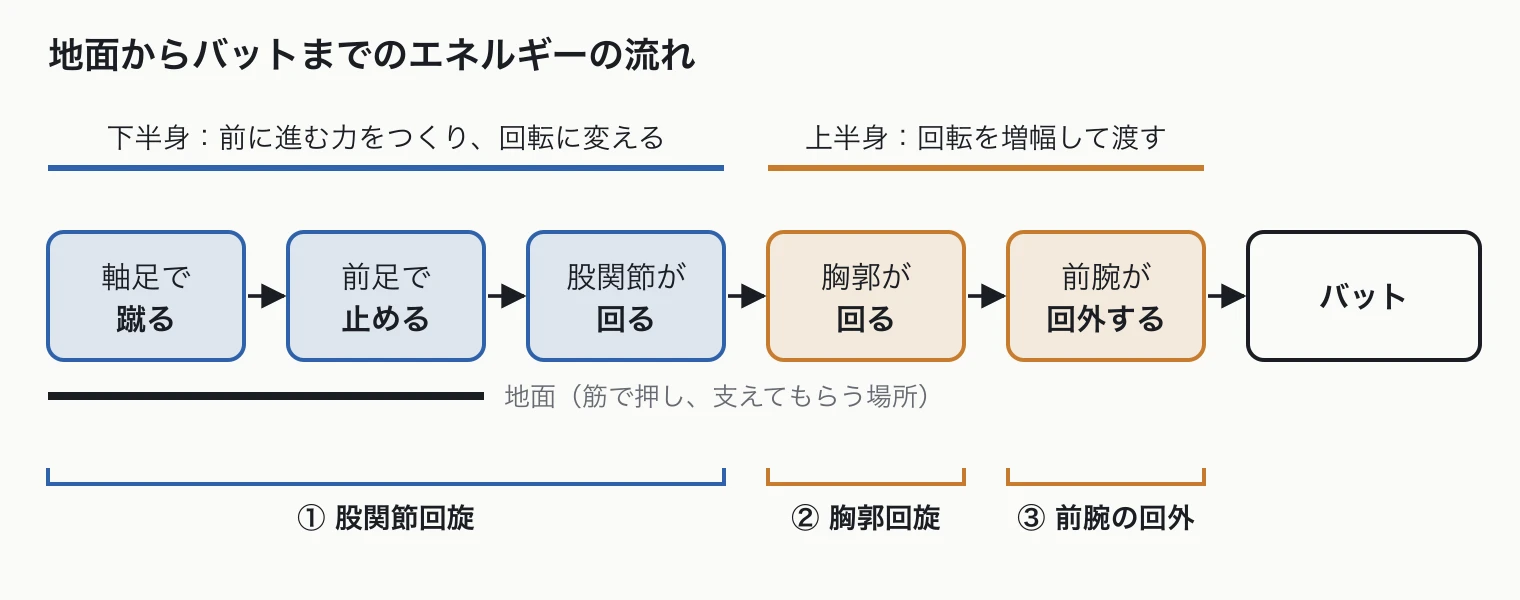
The order in which rotation generated by the lower body passes through the upper body on its way to the bat.
When the three link up well, the result is swing speed without loss. When one link is missing, the batter tries to make up for it with the arms alone, and the swing turns into an arm-only hit.
Hip Rotation
The muscles around the drive-leg hip push into the ground, the ground supports that push, and the drive-leg hip rotates. The muscles generate the energy; the ground is the fulcrum.
The lead leg catches that rotation, and the twist passes on to the upper body. As we saw last time, the single factor most tied to bat speed was the lead leg's catch. If this link gives way, what the drive leg built up never converts into rotation; it just leaks out.
What supports this movement is the thickness of the gluteus maximus (the large muscle in the buttock) and the flexibility of the hip joint. The physical conditioning program I wrote about before also uses dynamic stretching to work the area around the hip.
If a kid can't use this well, the drive-leg hip doesn't rotate; instead it straightens upward, and the loaded twist (tame, the stored-up twisting position) escapes. The swing tends to end up powered by the upper body alone, with the lower body never engaged.
Rib Cage Rotation
In coordination with the hips, the rib cage (thorax, the cage of bone formed by the ribs around the chest) rotates. Not the waist.
People often say "turn your waist (lower back)," but what actually looks like the waist turning is coming from the hip joints below and the thoracic spine above. Of the spine, the lumbar spine, at waist height, barely rotates at all; what rotates is the thoracic spine, at chest height. The hip is a ball-and-socket joint, the same type as the shoulder, and it rotates far more than the lumbar spine, standing alongside the thoracic spine as one of the two real contributors to rotation.
So it seems better to think of the upper-body twist in terms of the chest, not the waist. The flexibility of the rib cage and shoulder blades is what supports this rotation.
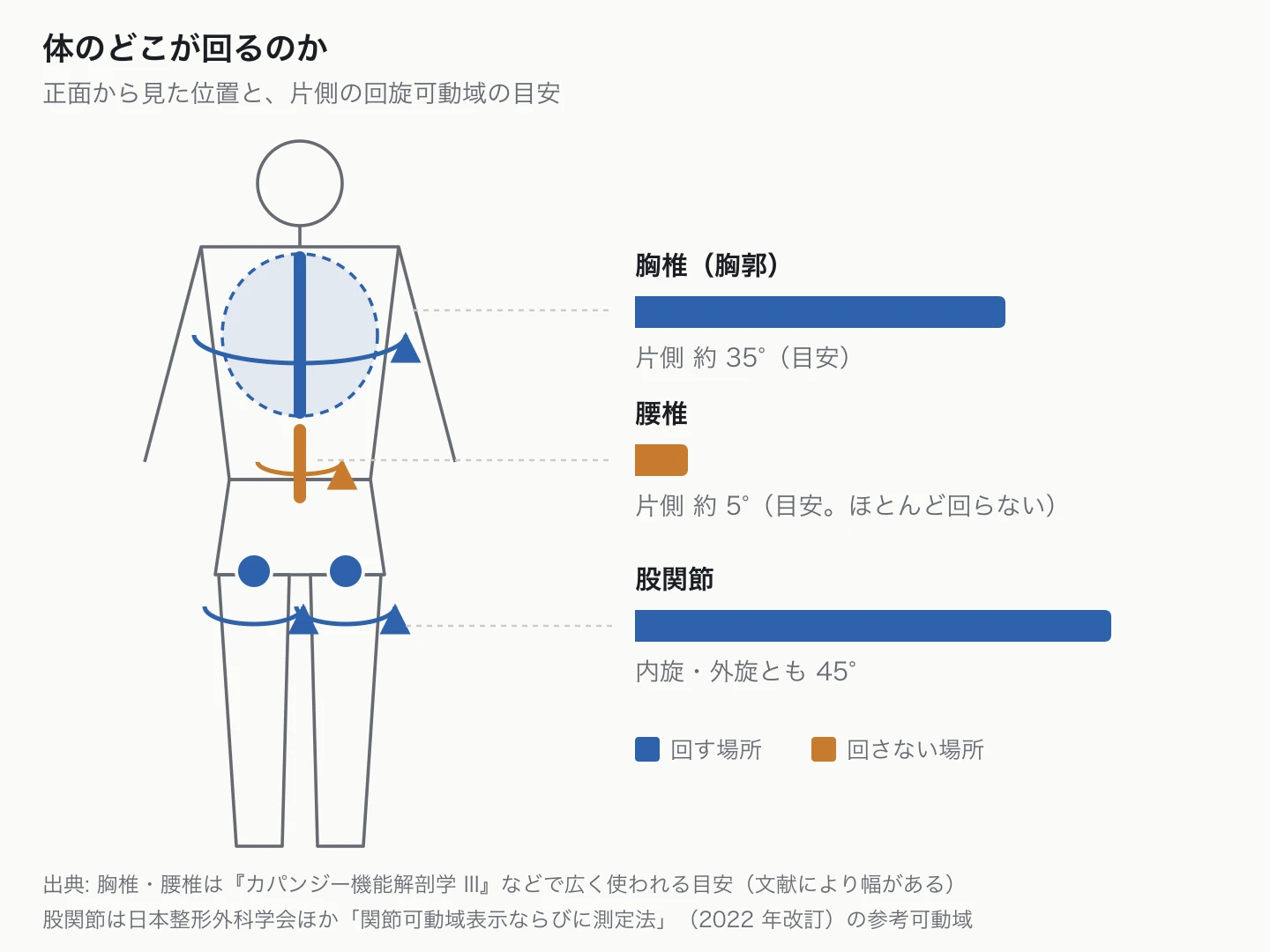
The positions of the rib cage/thoracic spine, lumbar spine, and hip, with a rough sense of how far each rotates to one side. The thoracic- and lumbar-spine figures are commonly cited textbook values and vary across the literature.
Last time, I mentioned a study of youth pitchers in which the lumbosacral joint, where the lower spine meets the sacrum (the bone at the center of the pelvis), generated the most power. The "joint" in that study treats the boundary between the pelvis and the trunk as a single joint, and that includes the motion of the thoracic spine. How much a joint rotates (range of motion) and how much power it generates (power output) are different quantities, so I don't think this actually contradicts the fact that the lumbar spine barely rotates.
The body works on a diagonal. For a right-handed batter, when the rib cage twists to the right at the top (the fully loaded, bat-back position), the left hip appears to extend slightly.
The lead leg comes up without breaking this position. Once the lead leg plants and the drive-leg hip twists, the left side of the rib cage starts to untwist. The gap between the lower- and upper-body twist that this creates (the separation) works as a run-up for rotating the upper body all at once. What matters isn't the size of that gap but how fast it closes.
The rib cage doesn't just rotate what's handed up from below. On top of the now-still lower body, it adds another layer of acceleration on its own. This is the part my own feel for the movement had missed in the previous post.
Forearm Supination
Supination is the twisting motion of the forearm that turns the palm upward. When the forearm of the top hand (the right hand, for a right-handed batter) supinates, the bat head gathers momentum from behind and comes out close to the body.
"Close to the body" here refers to the bat head, not the grip. You're not pulling your hands in tight to your body as you swing; the hands pass a little away from the body, while it's the tip of the bat that swings in close. I think this distinction matters.
If the elbow flares out during supination, or the dominant hand manipulates the bat on its own, this path breaks down. A useful marker is that the grip doesn't drop, and the top hand stays under the bat all the way through impact.
Common Issues Among the Kids on Our Team
First, on the awareness side. The kids don't have a clear image of what a good swing looks like, and they can't objectively see where their own weaknesses are. Plenty of them also have little sense of using their lower body at all.
On the t side, the common issues are the head moving mid-swing so the ball can't be tracked from a fixed point, losing sight of the ball, and the bat following a different path in dry swings versus actual hitting. Trying to swing without being ready in time seems to push kids toward these patterns almost inevitably.
The issues on the F side come down to five things:
- Lower-body movement is small, and there's little sense of using the hips
- The drive leg can't rotate or push through the gluteus maximus, so the knee straightens upward, the eyeline wobbles, and the loaded twist escapes (often this needs adjusting the stance width)
- The lead leg can't brake, so the drive leg or upper body drifts forward (the drive leg rotates and the lead leg stops it; the two work as a pair)
- The spring created by thoracic-spine rotation isn't used, and the swing ends up driven by the hands
- The elbow flares out during supination, or the dominant hand manipulates the bat
It's rare for just one of these to be the sole cause; usually several overlap and show up together. Casting seems to trace back mostly to either hip control or timing. Plenty of kids can use their body well in dry swings but fall behind on timing against a live ball and end up rushing into an arm-only swing.
What to Watch For
The priority for observation builds up from the lower body: hips, thoracic spine, elbow, then wrist, in that order.
| Priority | What to look for |
|---|---|
| 1. Hips | Can the drive-leg hip twist strongly? Does the lead foot land with the toes turned slightly inward and rotate on the heel? Does the lead knee stay short of fully straightening? |
| 2. Thoracic spine | Is the rib cage pulled back at the top? After the lead foot lands, does the rib cage finish rotating quickly (or does the swing turn into an arm-only hit)? |
| 3. Elbow | Does the elbow pass alongside the ribs without flaring out? |
| 4. Wrist | Does supination use the space behind (toward the catcher)? Does the bat head start from close to the body, without the grip dropping? |
The elbow isn't one of the three basic movements, but I watch it as the place where casting shows up.
What I check at every stage is whether the head stays over the trunk's central axis, and whether the forward lean holds. If the head moves, t breaks down no matter how correctly the hips and rib cage are working.
Coaching Points
The first is building the hip rotation. It's the single biggest foundation for generating F, and it helps t as well. If the hip fails to rotate and the leg straightens upward instead, the eyeline bobs up and down, so a hip that works properly protects t too.
Rapid acceleration from the drive-leg twist, followed by braking with the lead leg, creates a gap between the hip and rib-cage twist. I don't treat that gap as the goal in itself; I see it as a mechanism for producing the speed at which the upper body rotates all at once once the lower body has stopped.
The marker is the lead knee after rotation. Catching the rotation with the lead leg requires the knee to extend to some degree, but I coach kids not to extend it all the way. Last time, I wrote that in the pitching research, a straighter knee correlates with a faster pitch but also with more load on the elbow. For kids who haven't built their foundation yet, I think it's safer not to let the knee fully straighten.
Another marker is whether the pelvis has finished rotating fully over the drive leg.
The second is keeping the head over the trunk's central axis. The harder the lower body works, the more the head tends to sway. If the trunk can keep that in check, the head stays in place until the rib cage finishes untwisting. A lot of kids lose their forward lean partway through the swing, so building that forward lean in from the setup stage is one option worth trying.
The third is rotating the rib cage fully and quickly in coordination with the lower body. Rather than cueing the chest on its own, I pair it with the hips when giving instructions. The marker is whether the chest finishes rotating after the lead foot lands.
The fourth is using supination to make use of the space behind the body and let the head whip through. The marker is the head wrapping in close to the body without the grip dropping. This part comes down to hand technique and, compared with the rest, is more of a last-mile detail, but it's still worth checking case by case.
What We've Added to Practice
For warm-ups, we use hurdle walks (stepping over hurdles while walking) to build a feel for rotating the hips.
We've also added stationary tee work, something the team hadn't done much of before: hitting a ball off a tee while focusing entirely on form.
During full-team practice, it was hard to point out each kid's individual issues. Having dedicated tee time has made it possible to actually find and work on each kid's issues one by one.
What Got Through to My Eldest Son
With my eldest son, I had him focus on just two things: rotating the drive-leg hip and opening the chest. The only cue I give him mid-swing is a single phrase: rotate with your drive leg.
He had a habit of letting the drive-leg hip fully straighten during his swing. That habit has been improving little by little.
Takeaways
- Many kids don't have an image of what a good swing looks like in the first place. This is especially common among kids who are new to baseball or who rarely watch how other players, such as pros, move. They can't see their own habits objectively either, so even when you tell them "fix this," they're left not knowing what to compare it against.
- Just listing out the movements in words doesn't connect to a kid's own weaknesses. Even when you line up hips, rib cage, and wrist, to a kid they all seem to blur into the same single event of "swinging."
- So I decided coaches should watch using a single standard, while narrowing what we hand to each kid down to one cue. With the single phrase "maximize impulse," both the issue of the head moving (t) and the issue of an unused lower body (F) can be explained on the same yardstick. From there, each kid just gets one cue, something like "rotate with your drive leg."
I try it on my own body, put it into words, and then pass it on. This post is the set of words that survived that repeated cycle, but by next month the phrasing may have shifted again, if only a little (I'm still evolving, too).
References
- Body Control Through Extension and Rotation
- Developing Children's Physical Capacity
- 関節可動域表示ならびに測定法(2022年4月改訂)— 日本整形外科学会・日本リハビリテーション医学会ほか (a Japanese clinical standard for joint range-of-motion notation and measurement, published by the Japanese Orthopaedic Association and the Japanese Association of Rehabilitation Medicine, among others)
- Three baseball myths debunked by physics — Andrew Grant (2016, Physics Today)
- Physics of Baseball & Softball Bats: Forces between Bat and Ball — Daniel Russell (Penn State)
- Lower body energy generation, absorption, and transfer in youth baseball pitchers — Pryhoda & Sabick (2022, Frontiers in Sports and Active Living)
- カパンジー機能解剖学 III 脊椎・体幹・頭部 原著第7版 — A. I. Kapandji(医歯薬出版)(the Japanese translation of The Physiology of the Joints, Vol. 3, 7th edition)
Comments
Share your thoughts or questions. Comments are published after approval.
Write a comment