I've been getting a little better at baseball.
Ever since I started coaching my sons' team, I've been fielding grounders and taking swings alongside the kids, and at first I was genuinely worse than they were.
Lately I've finally been able to put into words why I was so bad at it.
Extension and Rotation
It seems to me that human body control breaks down into two broad components: extension and rotation.
Extension is the movement of straightening a bent joint to generate force; rotation is generating force by twisting the body.
Almost no movement is made of just one or the other — in practice it's a question of which one carries more of the weight.
And nearly my entire athletic career, up to now, has leaned toward extension.
Extension Is About Throwing Your Weight Into the Ground
The weight-training Big Three — squat, deadlift, bench press — are pure extension. A basketball jump, a sprint start, contact in rugby or American football: these are all, fundamentally, extension movements that create impact.
I played basketball in elementary and middle school, rugby in high school, and American football in college, which means I spent more than a decade doing almost nothing but this kind of movement.
To make your extension stronger, you first need strength — but strength alone hits a ceiling.
What matters beyond that, I think, is throwing your body weight into the hardest surface on Earth — the ground — and making good use of the reaction force that comes back.
What matters for using that reaction force well is the coordination of the pelvis and joints — the technique of transferring body weight into the ground efficiently. This is clearly a skill in its own right.
Much of track and field training seems designed around making good use of this ground reaction force. I suspect running itself is broken down and practiced as a matter of how you apply force into the ground.
Rotation Bends Extension Sideways
Baseball's fundamental movements, on the other hand, lean toward rotation.
Both batting and pitching use extension and rotation together. But when you want to generate more force, my sense is that rotation is what really matters.
And it turns out rotation wasn't something I was very good at.
Even when I swung the bat, it felt like I was swinging with just my arms, with no real force behind it. Even when I threw the ball, I always had this feeling that I was throwing from the shoulder on out, and nothing more.
It's only recently that I've finally started to feel, and actually use, the energy of the twist.
Putting the feeling I've picked up into words, it goes something like this:
- You push off the ground with your drive leg (the back leg). This is pure extension, and it's what creates the energy that carries your body forward.
- When your lead leg (the front leg) plants and brakes that forward motion, the forward-moving energy, with nowhere left to go, bends into a horizontal twist and flows into rotation.
In other words, I don't think rotation is generated from nothing. It's the energy created by extension, converted into rotation by the lead leg's braking action.
What tipped me off was noticing the similarity to skiing, which I've been doing since I was three. That feeling of your body rotating inside itself when you plant your skis and brake through a turn was exactly this.
So when you're trying to generate real power through rotation, the biggest obstacle is the braking leg giving way. If the lead leg slides instead of holding, the energy you worked to build up moving forward doesn't bend into rotation. It just leaks straight out.
That's what people mean when they say your base has to stay solid. Standing your ground isn't for generating force. It's for redirecting it.
When I swing with this feeling in mind, the ball clearly carries farther. I can tell the output has changed, whether in the toss-batting I do between coaching drills or in pitching.
Which brings me to the next question: how do I pass this feeling on to the kids? I still haven't found the right words.
Checking the Evidence
Since I'd gone this far, I decided to dig into the biomechanics literature and see how well this feeling actually holds up.
The results were better than I expected. The basic skeleton of "push, brake, rotate" is broadly supported. It was the details where I turned out to be off.
One caveat up front: almost all the studies I'll cite here are correlational. They show that two quantities move together, and nothing more. My intuition hasn't been proven. What I've found is material that doesn't contradict it. Please read what follows in that spirit.
Muscle Mass and Coordination Aren't in Conflict
Let's start with extension. My sense that "you need strength, but strength alone plateaus" turned out to be largely correct. But the two halves of that sentence were backed up in completely different ways.
The first half is backed by very strong evidence. In 2021, Miller and colleagues at Loughborough University in the UK used MRI to measure 23 lower-limb muscles in sprinters, comparing elite athletes, sub-elite athletes, and non-athletes.
Relative to non-athletes, total lower-limb muscle mass was about 20% greater in sub-elite sprinters and nearly 50% greater in elite sprinters.
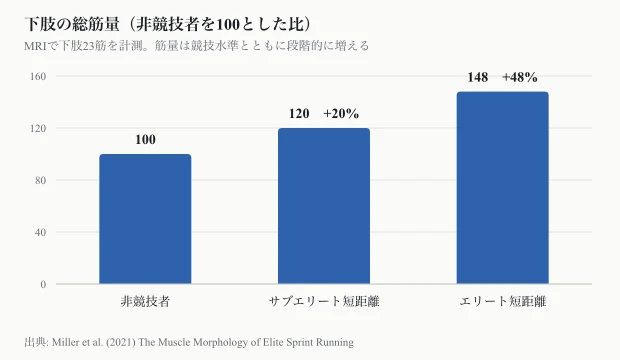
Total lower-limb muscle mass by competitive level. Chart based on figures reported in Miller et al. (2021)
What's more, the volume of the hip-extensor muscles alone explained 30 to 50% of the variance in seasonal-best 100m times. Even narrowing it down to the gluteus maximus by itself explained 30 to 40%.
The implication is that muscle mass is an important factor that matters a great deal.
What's interesting is an asymmetry within the same study. Isometric strength — the kind of maximum-force measurement you'd take on a test rig — showed no difference between elite and sub-elite athletes, and had no relationship with 100m times.
What matters is muscle mass in specific regions, not the number on a strength-testing machine. I suspect that when I felt "strength alone hits a ceiling," what my body was actually picking up on was this distinction.
The second half, coordination, isn't disproven either. In a 1994 simulation study by Bobbert and colleagues at VU Amsterdam in the Netherlands, making the muscles stronger without changing the recruitment pattern actually decreased jump height. Only after the control strategy was re-optimized did jump height improve.
Muscle mass sets the ceiling, and coordination determines how much of that ceiling you actually draw on. It turns out to be a matter of sequence, not conflict.
One place where my wording was imprecise was saying "ground reaction force matters." What correlates strongly with jump height isn't force itself, but impulse, force integrated over time. Peak force, if anything, correlates negatively with jump height.
It's not about pushing hard. It's about pushing for longer. That seems to be the point. When teaching kids to jump, it makes more sense to have them keep pushing through the ground contact than to have them try to slam down hard in an instant.
Push, Brake, Rotate
Now for the main subject: rotation. My sense that "the energy generated by the drive leg gets converted into rotation by the lead leg's brake" didn't contradict the research that has tracked energy flow.
There's a study of 24 youth pitchers that measured ground reaction forces and energy transfer between body segments simultaneously. It found that the force the drive leg pushes forward into the ground correlated with energy flowing into the body's core, the pelvis and trunk.
The braking force from the lead leg, meanwhile, correlated with energy flowing into the arm. The roles split cleanly between the leg that generates and the leg that hands off.
But again, this is just correlation. It's not a study that tracked the actual chain of events, energy generated by the drive leg being converted into rotation via the lead leg's brake. It's still possible that lead-leg force and energy flow into the arm are both large for entirely separate reasons. For now, my intuition is supported by circumstantial evidence, nothing more.
The correlation with pitch velocity also existed only on the braking side. In a study that measured adult pitchers with separate force plates under each leg, ground reaction force from the lead leg explained 45 to 61% of the variance in pitch velocity, while ground reaction force from the drive leg showed no significant correlation at all.
The same held for batting. The single variable that best explains bat speed is the resultant ground reaction force on the lead leg. In tee-batting by 20 college players, the correlation was 0.66, meaning it explained a little over 40% of the variance. The remaining just-under-60% comes from other factors, so this alone doesn't tell the whole story of hitting.
Even so, I suspect the feeling that "if the lead leg slides, the energy just leaks out" was picking up on something real here.
Let me insert a distinction here between force and energy.
Ground reaction force does no mechanical work, because the foot, its point of application, doesn't move. The actual energy source is always the chemical energy in the muscles; ground reaction force is apparently nothing more than a constraint force that mediates that conversion.
A study that quantified this during walking found that the external work calculated from ground reaction force was 73 joules, while the actual work done by muscles and tendons was 274 joules, nearly a fourfold gap. The authors conclude that external work shouldn't be used to estimate muscle-tendon work.
In other words, the muscles generate the energy, not the ground. From start to finish, the ground simply acts as a fulcrum that keeps the force the muscles generate from escaping. In that sense, calling it "energy created by pushing off" was actually accurate.
So read the following numbers as instantaneous force, not energy. During a pitch, the shear force the drive leg produces toward the target is roughly 0.35 to 0.48 times body weight, while the braking force absorbed by the lead leg is 0.72 to 0.77 times body weight. The first figure comes from MacWilliams and colleagues' 1998 measurement of seven college and high school pitchers combined; the second comes from the study of 24 youth pitchers mentioned earlier, so these are two studies of different age groups placed side by side.
In both studies, the braking side bore more force than the pushing side.
The Trunk Is Both a Converter and a Generator
I had thought of rotation purely as a conversion, bending the energy that extension created. But it turns out the trunk doesn't just pass energy through; it generates a great deal of its own.
In a study of pitchers aged 9 to 13, the joint that generated the most power during a pitch was the lumbosacral joint, where the lower spine meets the sacrum. It produced roughly twice the power of the lead hip and about eight times the power of the drive hip. This one study alone can't tell us whether the same order holds for adults, but for someone coaching kids, this is actually the more directly relevant finding.
So, more precisely, at the "rotate" step of push-brake-rotate, the trunk hits the accelerator again on its own. This isn't a movement that conversion alone can fully explain.
This changes how I should teach it, too. Telling kids "just brake with the lead leg and it'll rotate on its own" is wrong. After braking, the trunk needs to add another layer of effort on its own. This is a part my intuition had missed.
The extension-versus-rotation framework itself needs an update here.
The two aren't mutually exclusive categories. They're components that occur simultaneously within the same movement, shifting in relative weight. A baseball swing is probably better understood as three overlapping elements: extension of the drive leg, braking by the lead leg, and rotation of the trunk.
The "Size" of Rotation Matters Less Than I Thought
While I'm at it: the commonly repeated claim that "the bigger the twist, the stronger the throw" is looking pretty shaky in recent research too.
This is about the offset between pelvis and shoulder orientation, known as hip-shoulder separation. A 2026 study that measured 335 Division I college pitchers during games found the correlation between separation angle and pitch velocity peaked at just 0.16, explaining less than 3% of the variance in velocity. The authors themselves describe it as a "weak positive relationship."
That doesn't mean twisting doesn't matter, though. In the same pitching motion, the speed of trunk rotation explains 25% of the variance in velocity. What seems to matter isn't how big the twist is, but how fast it happens.
I've lined up all the numbers that have come up so far, converted to a common measure of explained variance.
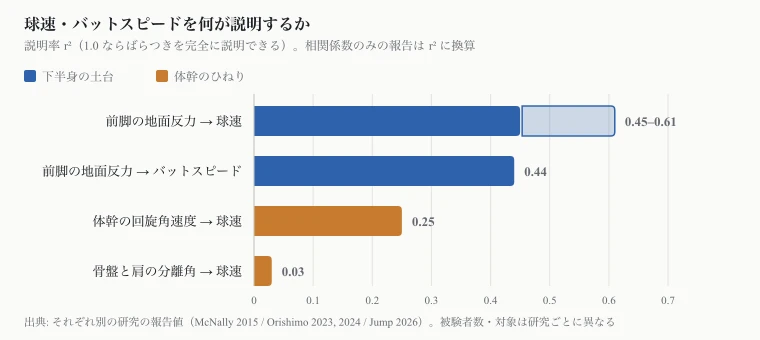
What explains pitch velocity and bat speed. Figures from separate studies, lined up on a common scale of explained variance
The two lead-leg findings sit at the top, and the size of the twist sinks to the very bottom. The very quantity that comes to mind first when you hear the word "rotation" turns out to matter least.
The textbook explanation of the kinetic chain, force transferring in sequence from pelvis to trunk to arm, also didn't hold up under measurement. In a study analyzing 71 curveballs thrown by 14 pitchers ranging from high schoolers to pros, not a single pitch followed the ideal sequence.
With only 14 pitchers in the study, I can't claim "no pro follows the sequence." Still, using strict adherence to the sequence as a coaching pass/fail line seems like a losing bet. I've decided to use the sequence not as a rule to enforce, but as a phrase to help kids remember each part's role.
The Lead Leg's Brake Comes With a Cost
Everything so far has conveniently confirmed my intuition, but one inconvenient finding came up too.
The firmer you plant the lead leg, the faster the ball goes. In a study of 121 professional pitchers, pitchers with good control had less bend in the lead knee at release, explained as a more stable plant.
But there's a trade-off. In a study of 100 pitchers combining pros and high schoolers, the overall trend was that for every degree the lead knee straightened, pitch velocity rose by 0.47 meters per second, but elbow valgus torque increased as well. That's load in the direction that damages the elbow.
Interestingly, the trend reversed between pros and high schoolers: for the pros, straightening the knee further actually decreased elbow torque. One way to read this is that straightening the knee before your base is fully stable is what's dangerous.
This is a point I can't afford to leave out when teaching kids.
Takeaways
- Even when your body has grasped something, the moment you put it into words, something important falls out. At first I almost described this as "I generate energy through twisting." The movement is the same, but that phrasing completely drops the drive leg's push and the lead leg's brake. And it's precisely the parts that get dropped that turn out to be backed up by the numbers.
- Even after adding back what fell out, it still wasn't enough. Even once I put it into words as "push with the drive leg, brake with the lead leg," that still leaves out the part where the trunk adds another layer of force on its own. What's more, the "size" and "speed" of the twist both feel like the same thing, just "twisting," to the person doing it, and there's no telling them apart without looking at the numbers. There were places tracing the felt sense carefully still couldn't reach.
- So what I'll teach isn't the feeling itself, but roles and markers I can actually verify. Push with the drive leg. Brake with the lead leg. Rotate with the trunk. And for the rotation, speed matters more than size. On top of that, don't fully straighten the lead knee. Narrowed down to this much, every piece is backed by numbers, and I can talk about the elbow-injury risk as part of the picture too.
Taking the sense of body control I've built up over an entire lifetime and reapplying it to a new sport is a genuinely fun exercise. And checking how far what I've grasped lines up with the numbers, and where it diverges, turned out to be a fun kind of learning in its own right.
References
- The Muscle Morphology of Elite Sprint Running — Miller et al. (2021, Medicine & Science in Sports & Exercise)
- Effects of muscle strengthening on vertical jump height: a simulation study — Bobbert & Van Soest (1994, Medicine & Science in Sports & Exercise)
- Relative net vertical impulse determines jumping performance — Kirby et al. (2011, Journal of Applied Biomechanics)
- Lower extremity kinematic and kinetic factors associated with bat speed at ball contact during the baseball swing — Orishimo et al. (2024, Sports Biomechanics)
- Role of Pelvis and Trunk Biomechanics in Generating Ball Velocity in Baseball Pitching — Orishimo et al. (2023, Journal of Strength and Conditioning Research)
- Stride Leg Ground Reaction Forces Predict Throwing Velocity in Adult Recreational Baseball Pitchers — McNally et al. (2015, Journal of Strength and Conditioning Research)
- Characteristic ground-reaction forces in baseball pitching — MacWilliams et al. (1998, American Journal of Sports Medicine)
- Peak horizontal ground reaction forces and impulse correlate with segmental energy flow in youth baseball pitchers — Howenstein et al. (2020, Journal of Biomechanics)
- The relationships between muscle, external, internal and joint mechanical work during normal walking — Sasaki et al. (2009, Journal of Experimental Biology)
- Lower body energy generation, absorption, and transfer in youth baseball pitchers — Pryhoda & Sabick (2022, Frontiers in Sports and Active Living)
- Influence of Hip-Shoulder separation on pitch velocity in college baseball pitchers — Jump et al. (2026, Journal of Biomechanics)
- Comparison of Kinematic Sequences During Curveball and Fastball Baseball Pitches — Scarborough et al. (2021, Frontiers in Sports and Active Living)
- Influence of Lead Knee Extension on Ball Velocity and Elbow Varus Torque in Professional and High School Baseball Pitchers — Dowling et al. (2024, Orthopaedic Journal of Sports Medicine)
- Pitching Mechanics and the Relationship to Accuracy in Professional Baseball Pitchers — Manzi et al. (2022, American Journal of Sports Medicine)






Comments
Share your thoughts or questions. Comments are published after approval.
Write a comment