After I wrote Body Control Through Extension and Rotation and Body Control for a Good Swing, I got a message from Mizuguchi-san. He worked as a trainer for the Toronto Blue Jays and now runs Katalab. It read like this:
I can walk you through the evidence and theory behind these topics, so if you're interested, why not talk over Zoom or something? I'll lay out the sensorimotor system in a structured way, and I think you'll enjoy it once you can see how it all fits together.
The invitation appealed to me, so we spent about an hour talking online.
In my first two articles I wrote down my own interpretation of how the body moves. This conversation went further back, to the nerves and senses underneath, and then forward to how to talk to players and how to set up practice and the environment. It was a dense hour.
A professional trainer had spent years working from evidence and real-world results, and I got to learn it in a short time. I'm grateful for that, and I want to write it up again for people in a position like mine.
About Mizuguchi-san
Shohei Mizuguchi is a physical therapist. He started at Harasanshin Hospital in Fukuoka, then studied at clinics in Australia, the UK, the US, and Canada. He spent three years with the Blue Jays as the link between the medical staff and the people on the field. Today he is based in Kyushu, where he works on relieving chronic pain and improving athletic performance.
Separate Function from Form
- Look at a player's problem as two things: function (what the body is capable of) and form
- Form is the shape that lets that potential come out in full. It should happen automatically. You don't think about your elbow angle when you toss trash into a bin
- Many kids still carry around "raise your elbow" or "release out front" from past coaching, and can't even use the function they already have
- So the first thing that works is subtraction, not addition. Ask what they're thinking about when they throw, take away one unneeded thought, and the movement improves
- Only after that, raise the function itself
In my case, ankles stiffened by a sprain from my basketball days became the bottleneck when I started American football. In my last year, my trainer had me do almost nothing but ankle mobility work. That was a function-raising exercise. My ankles were stiff, so that was the only form I could produce.
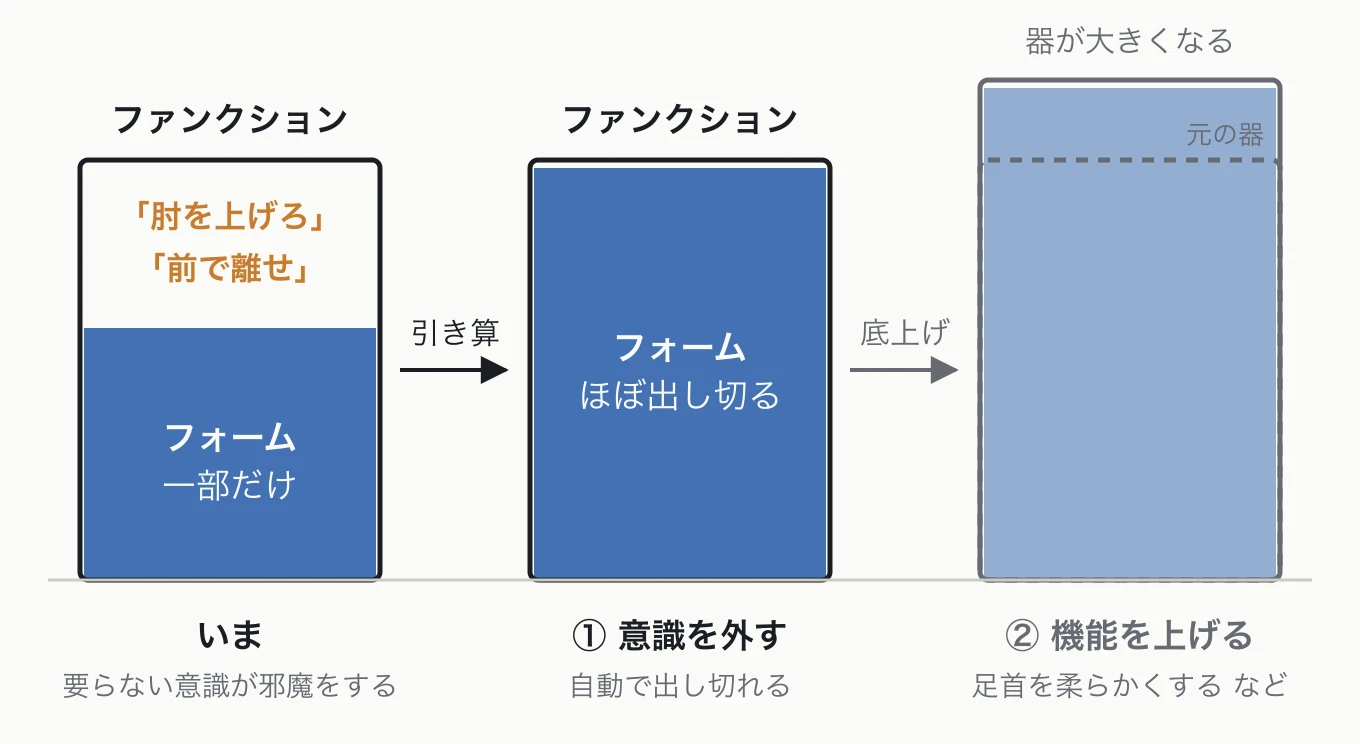
Function is the container; form is how much of its potential you draw out. First remove unneeded thoughts, then make the container bigger (schematic)
Keep Attention Outside the Body
- Cues come in two kinds: those pointing inside the body (internal) and those pointing to a target outside it (external)
- Internal cues improve movement only for beginners. From intermediate level up, they clearly make it worse. It's like thinking about your elbow angle the moment you reach for a cup, and suddenly you can't pick it up
- A 2021 meta-analysis also found that external cues work better regardless of age or skill level
- A coach's job is to work backward from the movement to the external target it comes from, and hand over only the goal
- For a stance: not "bend your knees, sink into your hips, shift your weight back," but "grip the ground"
- For a swing: not "accelerate behind you," but "swing so that if you let go of the bat, it flies toward center field"
- In youth baseball in Japan, many kids' bats fly toward foul territory when released. If it flies to center, that's a sign they're swinging with good timing
- In American youth baseball, most coaches have never played (about 70% by Mizuguchi-san's estimate). All they say is "throw hard" and "hit a home run." That is the purest kind of external cue
On game days, I often see coaches on my own team keep calling out "elbow, elbow." I appreciate the passion, but now I understand clearly why it tends to backfire. What I watch is inside the body; what I say is outside it. I'll keep the observation table from my last article as the coach's eyes, and point only the words that come out of my mouth outward.
If You Measure It, They Learn Without Being Taught
- Instead of hitting into a net at close range, hit in a way where you can see the distance. If throwing, measure the speed
- Just keep the feedback loop turning and say nothing else. Let the player figure out for themselves that this way goes farther, or that this much effort is faster
- Kids' own wants already point this way: "I want to hit it far," "I want to know how fast that was"
What "Athleticism" Really Is: Sensation
- Movement is a loop: sensory input, integration in the brain, motor output
- What people have long called "good motor nerves" (in Japanese, 運動神経がいい, roughly "athletic") means the input side, the senses, is excellent. That's why such people balance well and move the way they intend
- It looks like an innate difference, but senses improve when you give them stimulation. So they can be trained
- The senses that support movement fall into three groups: vestibular (deep in the ear, sensing head tilt and acceleration), vision, and somatosensation (skin, muscles, and joints, sensing touch and body position)
- A question Mizuguchi-san often asks in seminars: which is harder to build, a robot that throws a strong punch on a punching machine, or a robot that can pick up a strawberry?
- The answer is the strawberry. Sensing the size with fingertips, deciding in an instant how much force avoids crushing it, and then picking it up is far harder. Differences in athleticism show up in this ability to sense and modulate
When I played American football, I spent twice as much time watching video as I did practicing. Looking back, I think it was a way of reconciling the image in my head with what my body actually did.
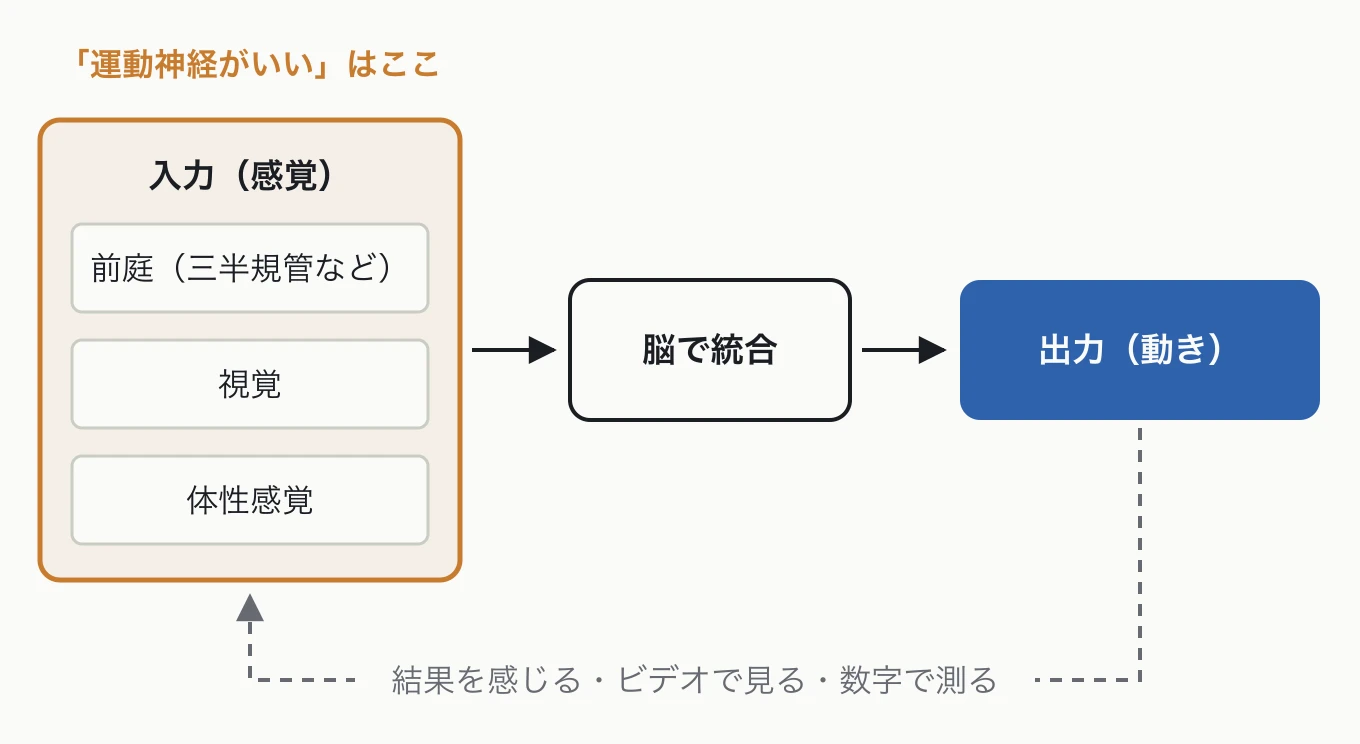
The brain integrates sensory input and produces movement, and the result feeds back as the next input. "Good athleticism" is a matter of input quality (schematic)
Grow the Nerves with New Movements
- Learning a movement and improving the senses are different things. If you only keep doing spider walks, you just get better at spider walks
- Mixing in new movements with variation beats repeating the same one when it comes to learning that transfers to other situations. A movement new enough to make you think "what is this?" is what works
- So keep feeding drills around the target function, and drop the ones that have become familiar. A deep bag of tricks that keeps the body from getting bored is a coach's strength
- Organize that bag as a grid: senses (vestibular, vision, somatosensation) crossed with body parts (neck, shoulder blades, hip external and internal rotation, trunk and spine). Fill in the cells for where you're working, and it becomes a system
On my team this year, we spend the first 30 to 40 minutes of practice on things like ladder drills (a ladder laid flat on the ground), mini hurdles, jump rope, and spider walks (crawling low on all fours), one per day. I started it because I figured nerves don't develop unless you move in all sorts of ways, and it seems I wasn't far off.
Start by Letting Go of Tension
- The key is relaxation. Surprisingly many kids don't let go of tension even when lying down, sitting, or just standing
- Tension works as a defensive reaction that protects the body. When sensory information is uncertain, the body prioritizes safety and won't relax
- So first, add stimulation to somatosensation and the vestibular system to create relaxation
- Next, increase the movements you can do while staying relaxed. For example, lying on your back with knees up and lifting your hips. Many kids arch the lower back to lift. If they're relaxed, the lower back doesn't arch and the spine rises one segment at a time from the bottom. This state is called imprint
- From there, progress in this order: rounding, extending, side bending and twisting
- Don't over-arch the lumbar spine (lower back). Correct extension means lengthening while the abs hold the area under the ribs in place to some degree. Arching the lower back and thrusting the pelvis forward is weak extension as a function
- What we call "good posture" is about appearance. In terms of function as an animal, a slightly rounded posture is stronger. A boxer who sets up with an arched back looks weak
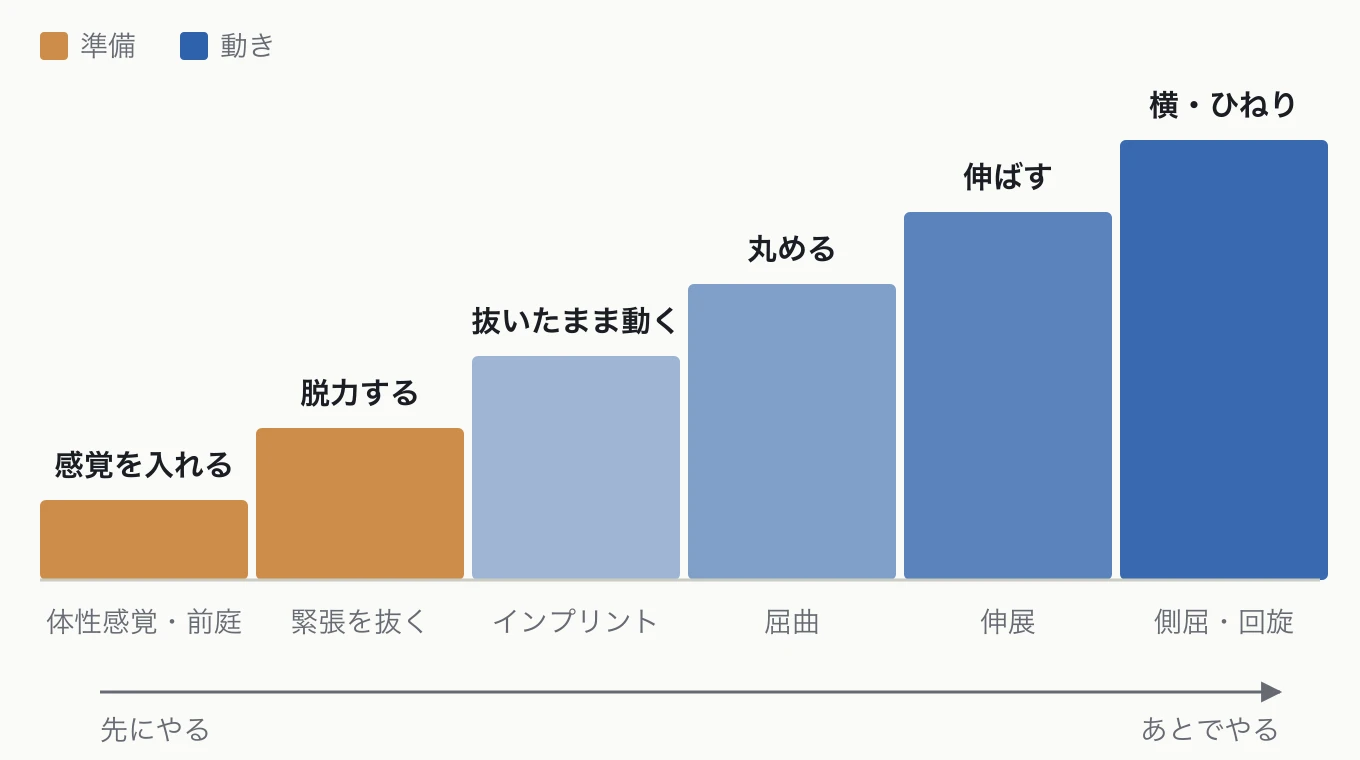
Add sensation to create relaxation, move while staying relaxed, then progress through rounding, extending, and side bending and twisting (a schematic I redrew myself based on the conversation)
Teams and Individuals Are Different Problems
- If you're stepping into a large team for a short time to raise performance, strength training is the right answer. Mizuguchi-san himself would choose strength training if asked to work with a 100 to 200 person college team twice a month
- The moment you shift to one-on-one personal training, the priority of weights drops sharply
- Research evidence leans toward strength partly because it's easy to measure, but also because strength training is the means that can lift a large group in a short time, so research gathers there
- When joining a team, first align on the coach's goals (win rate, nationals, body weight, batting) and the scope the trainer is responsible for. Quite often the goal and the means the coach wants are far apart
- Elementary school kids will do things if they're fun. Group practice is enough. What matters is getting them to buy into drills that seem unrelated at first glance
- Asked what practice improves hitting the most, Mizuguchi-san says playing catch. If you can't hit your target with your own hand on a ball that comes at you, there's no way you'll hit it with the end of a stick. Tell them that, and the kids start catching the ball with a satisfying pop, without any fuss
What the Trainer's Job Takes
- It's often seen as a technical job, but what works best is language skills. Building an argument and communicating it is the biggest bottleneck
- The standouts in this industry are strong at mahjong and poker. You read the situation, link up the options, and narrow them down by elimination. Assessing a body is exactly that game
Summary
- What disrupts a child's movement may often be unneeded thoughts planted by adults, more than a lack of function. The point that many kids can't even use the function they already have matches what I feel as a coach
- How you give cues should change with the player's level. For advanced players especially, cues that direct attention outside the body, and variety in those cues, matter more
- A coach's role is to hand over external targets and measurable results, not body parts. Building an environment where the feedback loop keeps turning is as important as finding the right words
After working out how the body functions on my own and putting it into words, I was truly lucky to hear more structured, firsthand know-how. Thank you, Mizuguchi-san.
Comments
Share your thoughts or questions. Comments are published after approval.
Write a comment