The legendary investor Warren Buffett has a clear investment criterion: invest in companies with high barriers to entry.
Which made me think: what exactly is a barrier to entry?
Companies — especially startups — aim for "high destinations, with high capital efficiency (speed)." In pursuing those destinations, the most important thing is said to be "avoiding competition" and "monopolizing a small market."
A "barrier to entry" seems to be a prerequisite for this kind of monopoly.
For example:
Peter Thiel's "go vertical" and Paul Graham's "Do Things That Don't Scale" can be read as: "Tackling complex things no one else wants to do makes barriers to entry more likely to emerge and enables a small monopoly."
Even thinking about Tesla and SpaceX, I think the key to these companies is complex, intertwined vertical integration. Did Tesla or SpaceX have the kind of massive breakthrough that makes headlines? Of course their achievements are remarkable, but there wasn't a single explosive breakthrough per se. What's remarkable is that they've developed by vertically assembling various factors. Tesla brought together auto dealers and made sure the profits they'd normally take didn't go to dealers — which is typical in the US auto industry. SpaceX did the same thing.
Conversely, the paradoxical truth that to get pulled into competition, all you need to do is "follow trends" seems to have some validity.

How I think about barriers to entry
What does a barrier to entry look like concretely? After studying examples from Japanese companies and thinking it through, I believe a genuine barrier to entry requires all three of the following:
- Hard to research because it's tacit knowledge
- Expensive and time-consuming to replicate after the fact / psychologically unappealing to copy
- Has long-term asset value and contains an embedded improvement process
For example:
- For Fanuc: automation technology itself as tacit knowledge
- For Yakult: its army of "Yakult Ladies" (direct-sales force)
- For Calbee: the B-to-B sales team and shelf monopoly at retail
- For Misumi: the on-demand delivery process
- For general trading companies: relationships with developing-country state enterprises, and vertical integration
- For Prudential Life Insurance: the high-speed education process for salespeople
- For Mercari: network effects
- For Toyota: TPD and TPS
- For Keyence: consulting strength (sales capability) and on-demand delivery process
- For Park24: car sharing
These all look like barriers to entry to me.
Understanding the job creates invention; invention attracts users; part of that gets continuously refined into a barrier to entry; that barrier enables the next job and invention. I believe we need to build organizations with that kind of process.
Content is hard to use as a barrier to entry
Slightly off topic, but: we're now in an era when "making content itself a barrier to entry is difficult."
One example: Calbee is heavily dependent on Alibaba for almost all of its Fulgra cereal sales in China. Calbee's chairman responded to this:
Platform companies like Alibaba have a big weakness. They don't make products themselves. Of course sellers are strong — but the people making things are stronger.
I read this as a typical case of positioning-talk.
As the world becomes more open, good content gets quickly reverse-engineered and copied. A "commodity" like Fulgra is exposed to this risk — the lead time before copying is short. The reason Alibaba doesn't make Fulgra is a matter of ROI — but if they wanted to, they could use their massive customer preference data to manufacture products of far higher quality and in far greater volume than Calbee.
ZOZOTOWN's private label brand is taking a similar strategy in apparel. jigen explicitly states the same strategy in their IR materials.
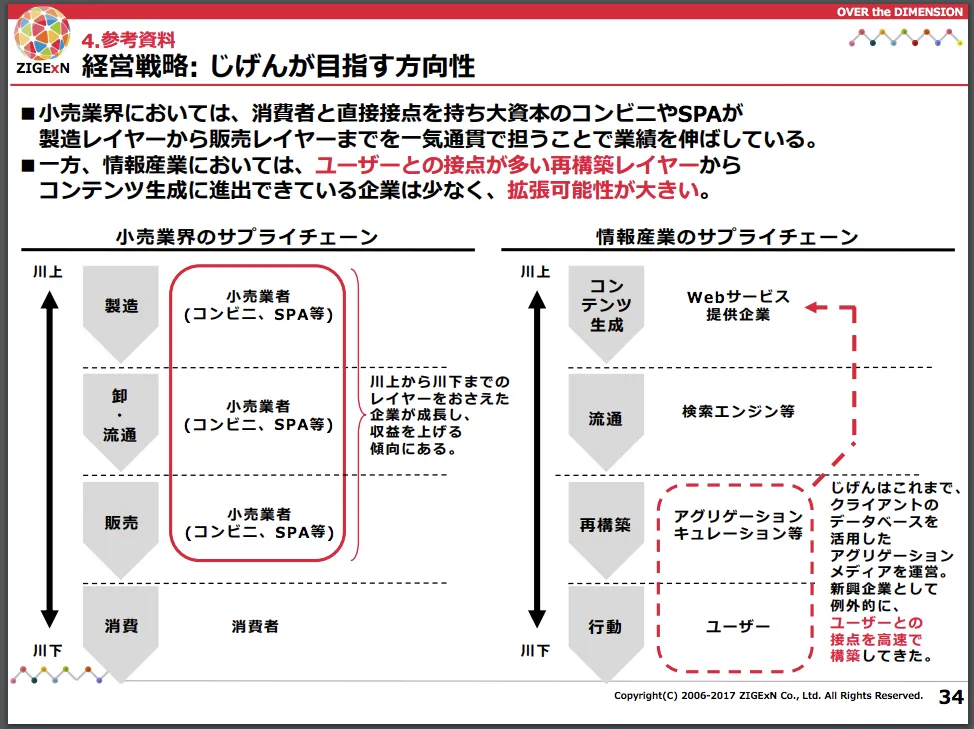
Easy-to-copy content gets copied even faster. And beyond that, consumer trend cycles move quickly too. Content alone is harder than ever to use as a barrier to entry — as long as "production generalization" remains a constant threat.
Own the delivery
The inverse of "content can't be a barrier to entry" is that controlling "delivery" — the mechanism that faces customer needs — is the contemporary gold standard for barriers to entry.
Google, Facebook, Gunosy, Cookpad, Netflix — IT companies that have built strong positions in specific domains all have strong value in their "system for delivering information."
Similarly, Seven-Eleven and Aeon built strong market share (store count) in their "system for delivering goods," locking in their position at the top of retail. This war is being carried into the drugstore industry too. The reason convenience stores compete on store count is essentially a battle for mindshare in delivery. "The ingenuity to get vegetables into many customers' hands, rather than the vegetable itself" — that's what tends to become a barrier to entry, as I understand it.
In closing
Companies carry many different kinds of significance and meaning. I think that's because they're complex systems where the intentions of many people intersect. But assuming going concern as a prerequisite, "the barrier-building game" seems like a certain kind of truth.



Comments
Share your thoughts or questions. Comments are published after approval.
Write a comment