Happy New Year.
As part of 10X's New Year initiative, I published an article called "Compound Management" on note. I worked hard on it, and I hope you'll read it.
This article is the B-side — the material that was too tangential to include in the main piece. Please read that one first.
What Actually Moves Productivity
In the note article, I disclosed the actual trend in "labor productivity" at our company. Mapped against company milestones, the productivity gains since 2024 are striking.
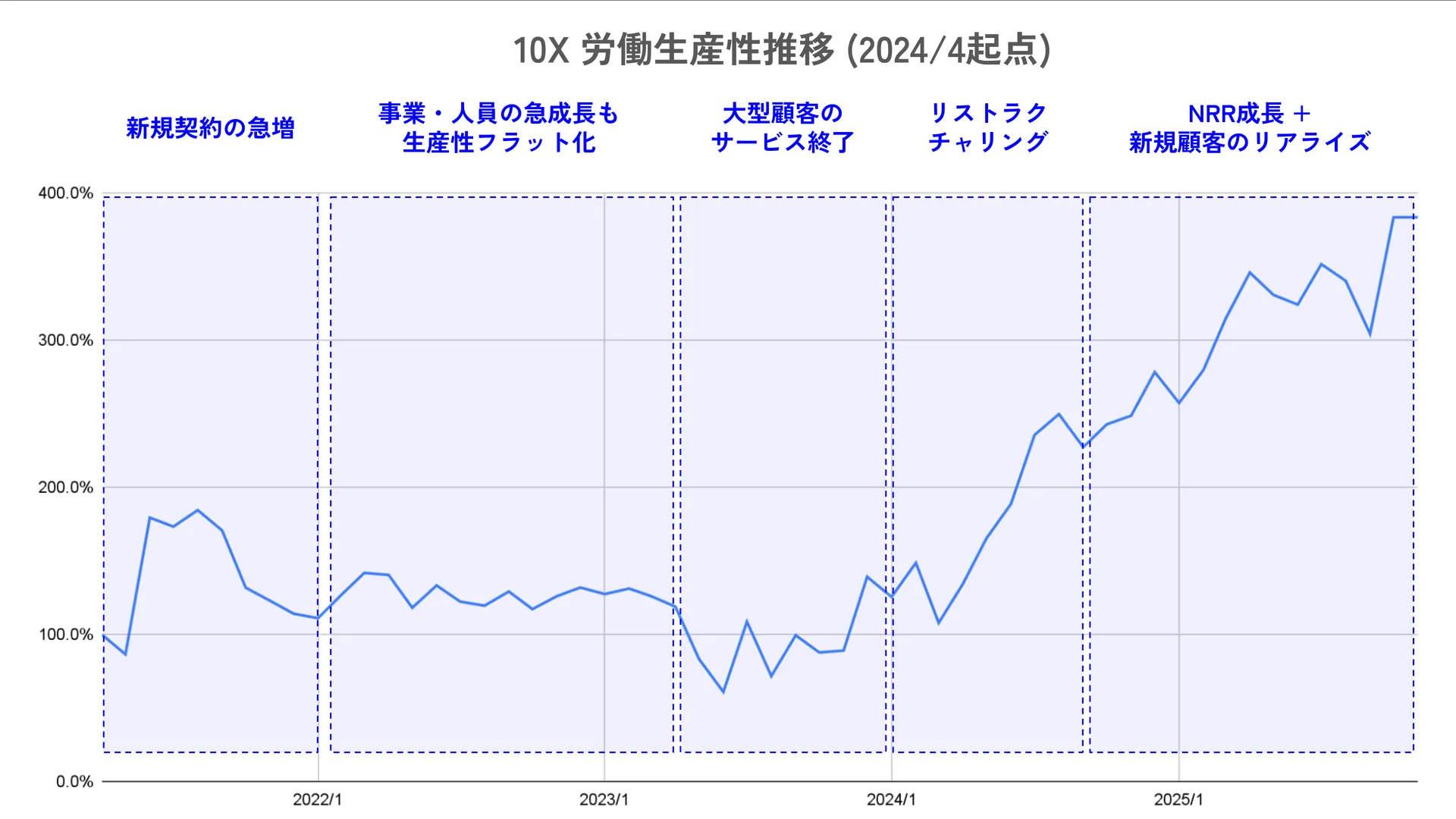
As I wrote in that piece, looking back over these four years, it's become clear what has and hasn't moved productivity.
What Moved Productivity
- Eliminating "work around it operationally" (pursuing true quality — at 10X we call this operational autonomy)
- Eliminating customization in software (platformization)
Both were primarily gains from refactoring investments in our software.
What Didn't Move Productivity
- Expanding corporate functions
- Growing the business organization
- Aggressive adoption of AI/LLM
Particularly on AI adoption — I didn't touch this in the note piece. I hold a stance that runs contrary to the prevailing trend, so let me dig into that here.
Skepticism Toward AI/LLM
I'm deeply skeptical of the narrative that "using AI has increased productivity." My reasoning comes from our own experience.
Like everyone else, we actively use AI at our company — primarily for software development and code explanation. Some concrete use cases have shown measurable results and are actively encouraged internally:
- Having AI write tests to improve unit test coverage
- Having Devin explain implementations from source code (used heavily by the business side too)
- Vibe coding for internal tools (I and our designers are the main users)
But these use cases remain at the level of "substituting or compressing part of the work time" or "filling in capabilities we lack." What's improving is efficiency, not productivity.
Improving productivity means either generating new gross profit or significantly replacing existing business operations such that the labor supporting those operations disappears. We haven't gotten there. The contribution to productivity is essentially zero.
My skepticism is rooted in the belief that this is basically the situation inside most companies.
From this stance, I'm also "Sell" on global AI investment (domestic Japanese investments, I'm less sure about). I wrote about unwinding my S&P 500 position in this earlier post.
That said, I genuinely look forward to AI progress that would be compelling enough to overturn this stance. If and when that happens, I plan to reverse course fully and without hesitation.
Building Tomorrow's Productivity
I'm confident that 10X's productivity can be improved further in the short term.
The basis for that confidence: our investments in compounding structures are starting to bear fruit, and the transactions (revenue) flowing through those structures look set to grow strongly for the foreseeable future.
That said, every business eventually matures, and revenue growth rates inevitably slow. The Stailer net supermarket product in particular is beginning to capture meaningful market share in terms of total transaction volume, which means it will gradually converge toward market growth rates.
New Year Reflections for 2026
I can't predict exactly whether the current business matures three or five years from now, but when that moment comes, keeping productivity from plateauing will require creating new structures or new businesses.
I see it as my mission to lay the groundwork for that future now. This year, I want to deepen my domain knowledge of retail to the point where I can genuinely claim to be a domain expert — and then translate that domain resolution into the product.
In 2024 and 2025, I got significantly better at understanding retail operations. But my resolution is still not sharp enough, and I haven't yet built what I expect the product to be.
In the note piece I wrote: "Software quality is compound growth in another form." And software quality is the product of deep domain knowledge.
I want to dig into that foundational domain knowledge with an intensity that surprises everyone around me.


Comments
Share your thoughts or questions. Comments are published after approval.
Write a comment