"Business development (BizDev) should own the entire journey — from customer discovery and problem identification to solution definition, delivery, and success — end to end."
This is the "ideal" model of BizDev I've long held.
BizDev, as the name suggests, is the work of creating business — so for a long time I genuinely believed this integrated approach was the right way to do it. I promoted this model and tried to embody it.
But as the business has matured, the customer base has grown, and the problems have become deeper and more complex, I've been reconsidering. More specifically, I've come to think it may be unrealistic to expect one person to handle all of this.
Today I think about business development through two concepts: Vanguard and Rearguard.
Sometimes one person integrates both roles; sometimes we consciously separate them. What matters is recognizing that they are fundamentally different things.
Here's the background to how I arrived at this distinction, and what I mean by the different types of uncertainty each role faces.
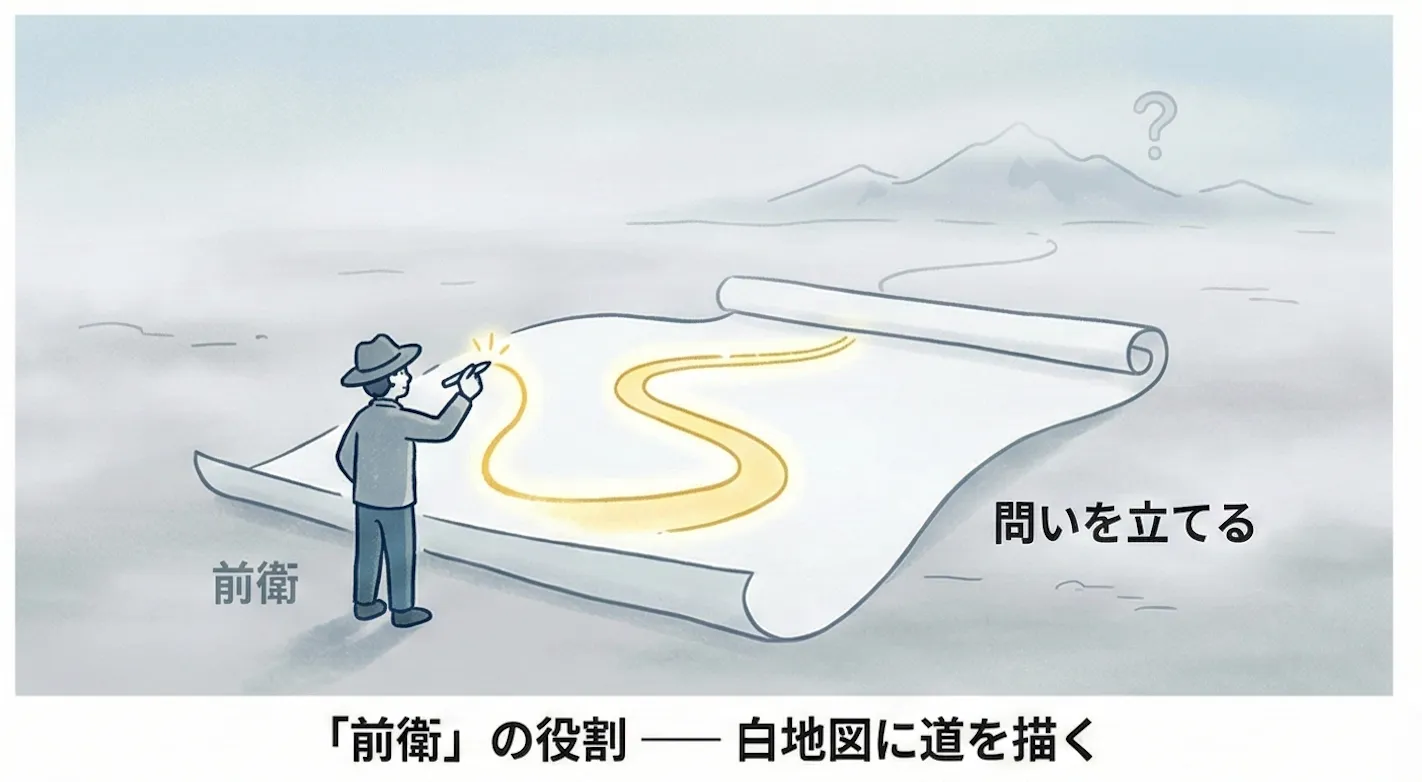
The Vanguard Role — Drawing Roads on a Blank Map
The Vanguard faces the uncertainty of setting the right questions to solve.
Most business operations move forward through a "gap-fill" approach — identifying the gap between the current state (As-Is) and a desired future state (To-Be), then closing it.
But the Vanguard's position isn't there. They start from a place where the "desired state" hasn't been defined yet — or where even the customer hasn't noticed that they need something.
Finding Potential Customers and Framing the Question
The most critical capability for the Vanguard here is: defining and gaining agreement on the problems that future customers need to solve.
Sometimes it starts with finding the potential customers themselves — customers who haven't yet surfaced.
There's no map, no signs. You're standing in an unmapped wilderness, drawing the first line with a piece of chalk.
Extracting, from a chaos of customer voices (sometimes from people who can't even articulate what they want), the question worth addressing as a business — that is the Vanguard's essential work.
The measure of success here isn't just contract value or lead count. Sometimes the greatest outcome is the discovery itself: "so this is the problem we should be solving" — finding the seed of a business.
The Rearguard Role — Choosing at Every Fork in the Road
The Rearguard picks up the baton after the Vanguard has framed the question and built the customer relationship or contract.
What they face is the uncertainty of how to deliver on that question.
"The contract is signed — so now it's just execution, right?" one might think.
But delivery in a high-novelty business is the polar opposite of running a standardized workflow.
Sharpening Against Reality
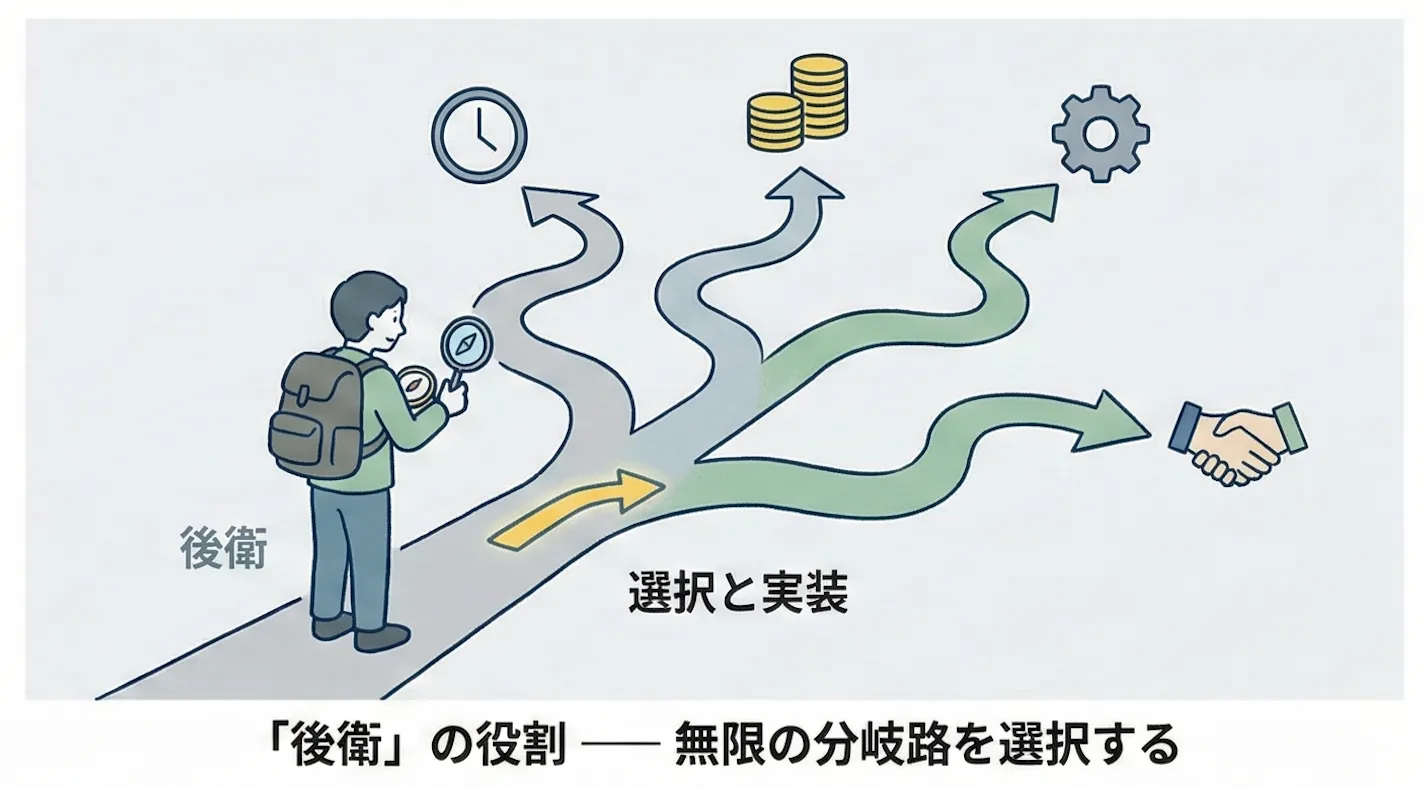
Once aboard the "road" the Vanguard has drawn, the Rearguard faces an infinite number of forks — choices between different "Hows."
- Chasing customer requests too closely balloons technical debt
- Prioritizing quality too heavily delays delivery and erodes the business's innovation
The Rearguard must continuously judge: among all these complex variables and customer demands, which path maximizes the impact of the project's landing? At times this requires difficult negotiations, internal and external.
It's not about finding a comfortable balance and steadily progressing. Sometimes the moment calls for bold moves — deliberately throwing the balance off in response to the customer's situation or your own company's needs.
And above all, the Rearguard must own full responsibility for these decisions throughout the delivery phase.
If the Vanguard's role is "to open the road," the Rearguard's role is "to keep choosing the best route from the infinite forks that appear as you travel it."
That's the image I have.
Why "Separation" Is Necessary
Vanguard and Rearguard.
Of course, if one person can do both at a high level, nothing could be better. And in practice, the required skills do overlap significantly. Customer understanding, logical thinking, communication ability — these fundamentals are common to both.
So why does the separation matter?
I think it's not a difference in skill, but a difference in disposition — or more plainly, a matter of what you enjoy.
- Vanguard: Gets a rush from diving into uncharted territory and creating something from nothing. Can genuinely enjoy ambiguity for its own sake.
- Rearguard: Finds pleasure in untangling complex, interlocked constraints and landing on realistic solutions. Thrives on finding the best answer within limits.
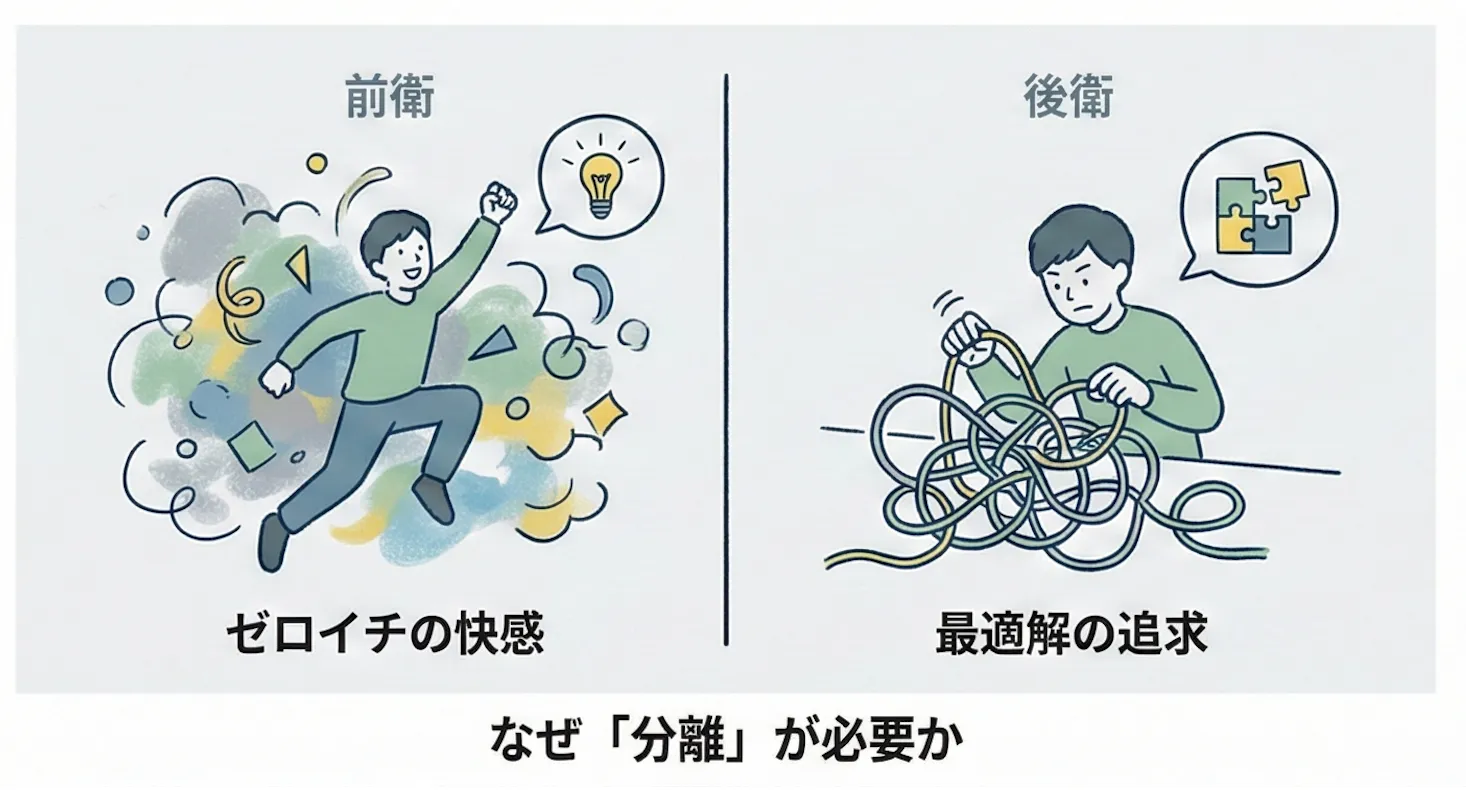
Neither is superior. "Drawing roads on a blank map" and "choosing optimally at every fork" are different as capabilities — but more than anything, what makes your heart race is different.
Rather than exhausting people by demanding they be supermen, creating an environment where each person can swing fully at the fight they love — that, I've concluded, will ultimately produce faster and higher-quality business outcomes.
Separating Roles, Not Creating Silos
This division of roles does not mean siloing the organization. My ideal is actually the opposite.
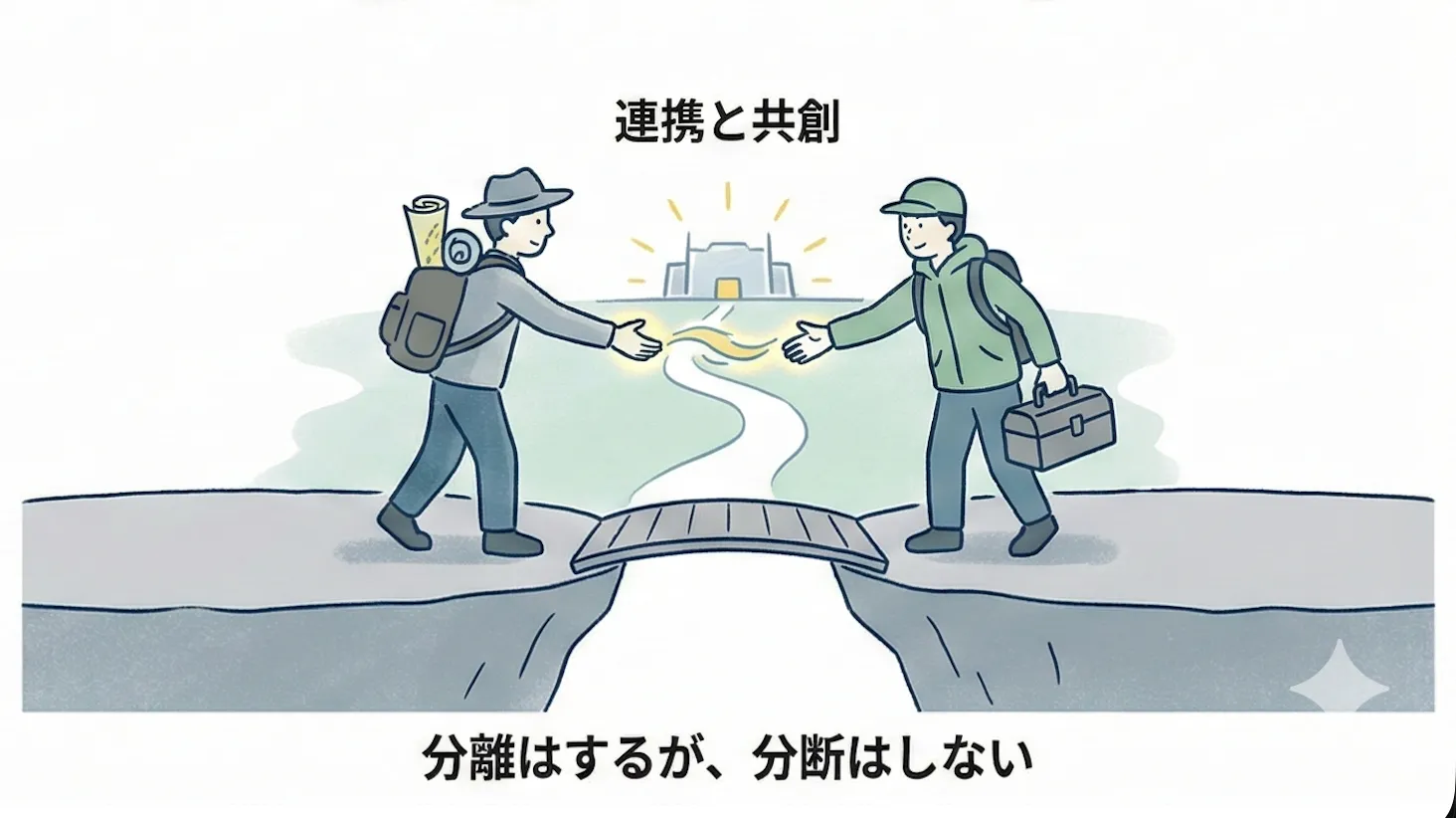
- The Vanguard, because they understand the difficulties the Rearguard faces in delivery, can make bold proposals that account for feasibility
- The Rearguard, because they deeply understand the true customer challenges the Vanguard has surfaced, can complete the project without losing their compass when decisions get hard
"Dividing a continuous role among individuals who are discontinuous with each other."
While the roles are primarily separate, experience in both areas offers significant benefits to anyone building a career as a businessperson. What matters is being conscious of which mode you're currently in, and which type of uncertainty you're fighting.
That Said, Supermen Exist
The business builders I find most impressive can transcend this distinction entirely — handling both concepts alone with ease.
Even at my company, there have been — and are — a small number of players who can operate fully in both modes.
They are rare and exceptional, not to be taken as the baseline when forming a team.
In most cases, what matters is not stretching beyond your range, but having the clarity to accept "this is where I'm limited."
That said, as an aspiration for what a business builder might become, knowing that these supermen exist is probably worth keeping in mind.





Comments
Share your thoughts or questions. Comments are published after approval.
Write a comment