Building a product, at its core, is about deepening your "attention to the subject." The driving force is a kind of obsessive curiosity about someone.
I often use the phrase "getting closer to the facts." What did the person who picked up our product feel, what did they want, what did they ultimately do with it? What disappointed them?
What I often sense is that the blank space where "products or features born of the creator's ego" can succeed as lucky hits is getting narrower and narrower. Deeply understanding what people need and building something to support achieving it seems like the only way to "build something people want."
Understanding "someone" correctly is incredibly hard. I try to approach and observe, but I'm wrong constantly. Even so, when "obsessive curiosity" is the driving force, I keep trying to understand. Occasionally I have a "maybe I understood a little" moment, and I deepen my understanding of "someone" through accumulated those moments.
Having taken risks and iterated through trial and error myself, I've started to have some sense of "how to deepen understanding." In this post, I want to introduce three tools I use in everyday product building to understand users.
1 / Interviews
I use this to understand the meta-level background: people's lives, habits, personalities, environments. Conversely, almost never do I ask about "the product." I give extreme weight to understanding the context of the users of our product. Who they're with, in what scene, with what feeling, how they use it.
But almost no one can accurately answer questions about context. Interpreting context and placing the product in their life — that's our role. The product doesn't interest them at all. I never ask about it.
Instead, I aim for "a conversation where the other person can answer with facts."
- How many people live in your household?
- How many children do you have?
- What time do you usually pick up the kids?
- What foods do your children eat well?
- What time do you usually finish work?
While hearing "facts about life" like these, I search the conversation for emotions that occasionally slip out, or further hidden facts.
When the interview ends, I should be able to clearly imagine that person's day from waking to sleeping. That's the goal of an interview. I take those qualitative but clear views and build them into the product.
If you want to improve "something that already exists," interviews are almost a waste of time, I'd say. What I pick up from interviews is hints to "something that doesn't exist yet."
2 / Funnel analysis
To understand "where" in an existing product the problem lies, data is best. Among all approaches, mastering funnel analysis alone means you can improve anything else — that's how much I lean on funnels.
Good data is expressed in "rates." The representative of that is funnels. But you can't be satisfied with one funnel. For example, the funnels I've used internally at Tabery number well over 30. Large funnels and granular funnels both have value, but granularity matters for "connecting to specific actions."
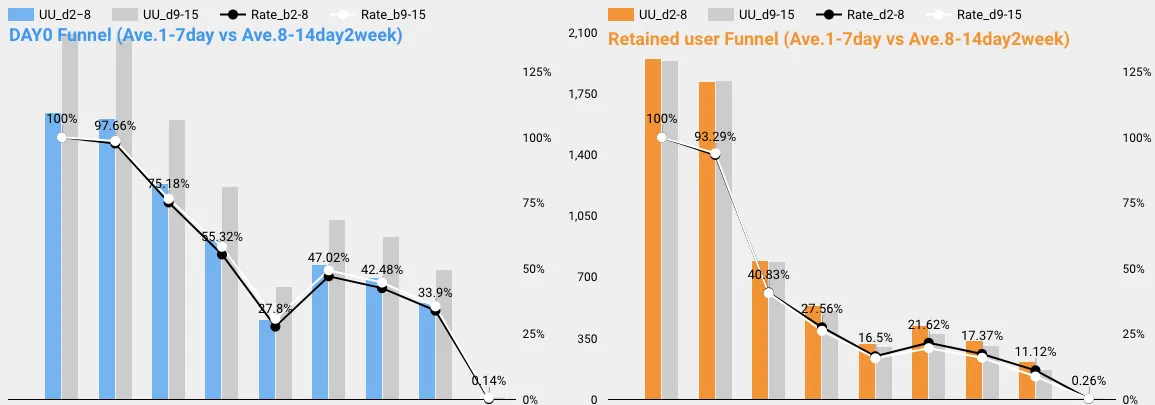
- Large funnel: from visiting the product to completing purchase (core action), etc. Monitor consistently and roughly prioritize problem areas.
- Granular funnel: exactly which of the 5 screens between app install and completing onboarding do users drop off from, and by how much — monitor extremely granular funnels. Used to pinpoint the source of problems.
When "improving" a product, the first thing to do is "identify the location of the problem." Funnels show that location with exceptional clarity.
3 / Usability testing
If funnel analysis is the method to analyze the location and priority of problems, usability testing is extremely effective for finding the cause of a problem through observation.
For example, say there's a large dropoff in the transition from screen A to screen B. You can also validate the cause with data.
E.g.:
- "Is the load intolerably slow?" → Measure response time
But when you truly want to understand the facts behind it, you want to combine observation if possible.
Tabery was built through repeated usability testing. The details are in another post, but we continue to do usability testing repeatedly even after launch.
A tool I've heavily relied on as a substitute for usability testing is a product called Repro. With permission from some users, it records usage video that you can observe.
As of March 2019, Repro discontinued this feature and it is no longer available.
Meeting users requires significant energy, but with Repro you can filter — like "users visiting the app for the second time who have started looking at product pages" — and record only that segment. You can record only the problem areas identified in funnel analysis, enabling highly efficient improvement.
Not meeting in person also has significant advantages. Users, once you've met them, out of goodwill will often push through screens they would have actually dropped at. For observing truly objective "usage patterns," Repro is superior (in exchange, you can't see the facial expressions or finger movements visible when meeting in person — so use each appropriately).
In closing
So while I intended to write quickly, it got long, but:
- "Understanding people → interviews"
- "Understanding the location of problems → funnels"
- "Understanding the cause → usability testing"
That's the breakdown I use, deployed appropriately while facing users.
As I keep saying, the starting point and driving force behind all of it is "obsessive curiosity about the other person." I want to keep genuinely facing the people I want to deliver value to.


Comments
Share your thoughts or questions. Comments are published after approval.
Write a comment