Inspired by a forward-looking manifesto called "The World Transformed by Smartphones (Part 1) / (Part 2)," I've decided to put my own thinking about where the future is headed into words.
Near the end of The World Transformed by Smartphones, there's a passage that reframes the giant services we perceive as the "sharing economy" from a different angle:
If you think about things this way with a slightly longer view, we're in a period where we're still building the parts that reconstruct the interface between cyber space and real space. It's similar to the phase after smartphones appeared, when apps and SDKs were being built to construct the smartphone's cyber space. — The World Transformed by Smartphones (Part 2)
What does it mean to "reconstruct the interface between cyber space and real space"? And why is that important? These two questions are exactly what occupies my thinking right now.
The interface between cyber space and real space requires two components: "sensors that track real-world things and set them in motion," and "the mechanisms and interfaces to control those sensors from cyber space."
In 2018, mobile devices play the role of the sensor in most cases. And mobile is also the main actor in the "mechanism for control."
This is probably because people carrying mobile devices has been the defining trend of the last decade. As the number of people worldwide carrying mobiles grew, services emerged that could sense and act on things via mobile.
Airbnb provided a "listing function" as the sensor for tracking the availability status and access of a home. Hosts can update the state of their listed property at any time from mobile. And travelers book availability through their mobiles.
Toreta, a restaurant reservation system, put tablets in restaurants to sense empty seat information and make inventory visible. Various mobile restaurant apps can then book against that inventory.
In Uber, iPads installed in taxi vehicles track "vehicle location and availability." A user sends a ride request from their mobile, and the nearest trusted driver is matched.
Mercari's "listing function" in its mobile app acted as a sensor for "the state and price of items sitting at home." Delivery services like Instacart and DoorDash sense "time that happens to be free right now" through mobile. The examples are endless.
What I believe is the essence of what we call the sharing economy is liquidity. It's about moving something that previously had low liquidity into cyber space, and giving it fluidity. Tracking and managing the state of "that something" accurately is the Day One of everything.
Mobile became the machine for sensing "vacant rooms," "empty seats," "available taxis," "surplus clothing and household items sitting unused," and "people who happen to have free time" — while also serving the dual role of the device through which people access all of it from cyber space.
The assumption that's about to change
What core assumption might change dramatically between now and the future? It's this: sensors will stop being mobile. This seems close to certain.
The idea of attaching sensors to all sorts of things — IoT — has grown steadily over the last decade, but it lacks the versatility of mobile. IoT, which must be purpose-designed, manufactured, and operated for optimal sensing in each use case, has cost challenges and distribution challenges that make it hard to say it has "changed how we live." But in the next ten years, those problems will certainly be solved.
When sensors far smaller than mobile, optimally designed for each individual object, are embedded into society at scale, that will mark the true beginning of cyber-physical integration. For those of us working on products and businesses, I can't think of a more exciting opportunity.
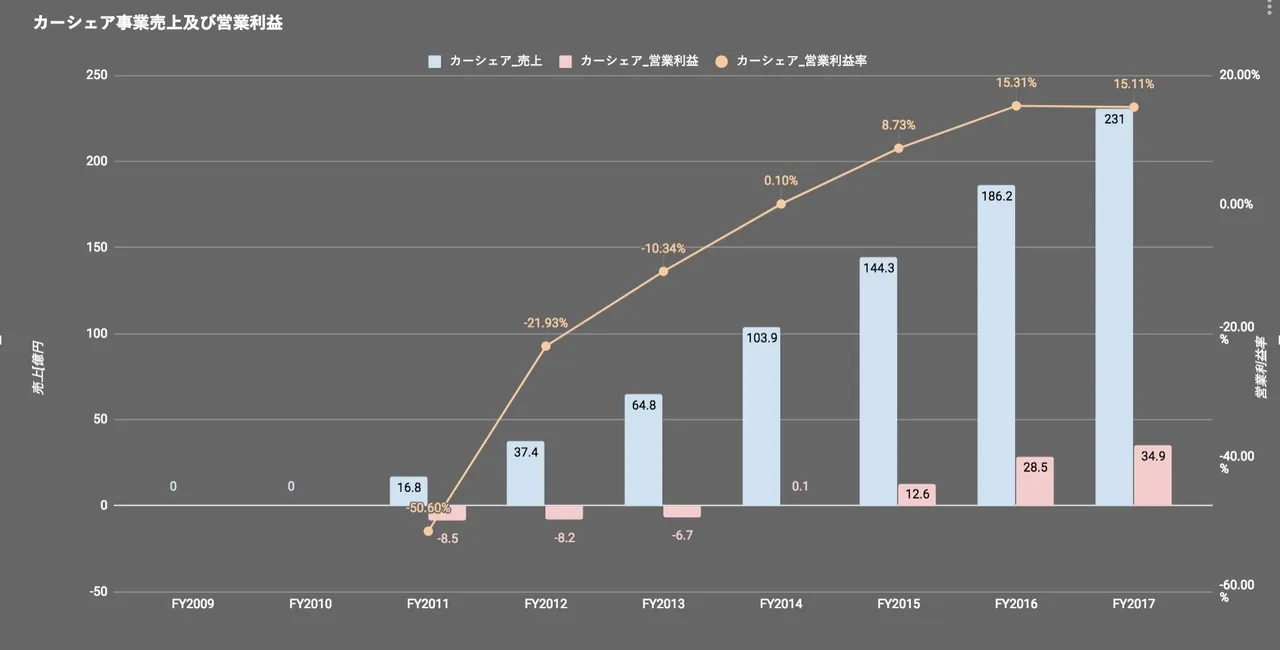
One company that has succeeded on both the business and product sides of this social implementation is Park24, which runs the Times Car Share service. They've deployed proprietary sensors across parking lots and tens of thousands of car-share vehicles nationwide to accurately track fuel levels, availability, and location — allowing users to make reservations at any time from mobile. In doing so, they created the car-share market.
They've absorbed B2C demand ("I want a car for short occasional trips") and B2B demand ("we don't need company vehicles anymore"), generating average revenue of 1.2 million yen per vehicle. The economics of "the more vehicles we add, the more we earn" have been in place since their full launch in 2010 — which is remarkable. And the foresight to have "acquired Mazda Rent-A-Car by M&A in 2009 to launch this business" is breathtaking (because 2009 is the year Uber was founded).
If it's near-certain that sensors will permeate the fabric of society to connect cyber and real space, then the big issues become: "where, when, and what kind of sensors will be needed?" and "what inventions do those sensors make possible?" Mapping those steps and executing on them is the role of inventors like us. That is: live in the future, and build what's missing.
As with the Times car-plus example, managing vehicles is a field with a proven precedent in Komatsu's KOMTRAX, which IoT-ized heavy machinery to efficiently manage and operate 60,000 pieces of equipment scattered around the world. Originally conceived for theft prevention and cost reduction, it was strategically transformed into a new business in its own right.
Most sensors that society will need going forward will be "designed from specific use cases and contain those use cases within them." I want to take on the challenge of inventing sensors like that myself.
I'm making steady preparations to deliver products that will literally transform society 10x. If you're interested in the ideas in this article or in our company, feel free to reach out via Messenger or Twitter DM.
Thank you for reading to the end. I'm currently running a company called 10X (https://10x.co.jp).


Comments
Share your thoughts or questions. Comments are published after approval.
Write a comment