I'm not a tall guy at 170cm, and when I was younger and pushing hard to develop my athletic abilities, there were plenty of moments where I wished I were just a little taller. I also suspect I could have grown a bit more than I did.
Final adult height is said to be about 80% determined by genetics, but that leaves roughly 20% open to influence. I don't want my kids to struggle over their height the way I sometimes did, so I bought a book called The Amazing Way to Grow Taller, Based on Data from 15,000 People, and my wife and I have been supporting our third- and sixth-grade sons' growth along the lines of what it teaches.
Background: The Growth Chart
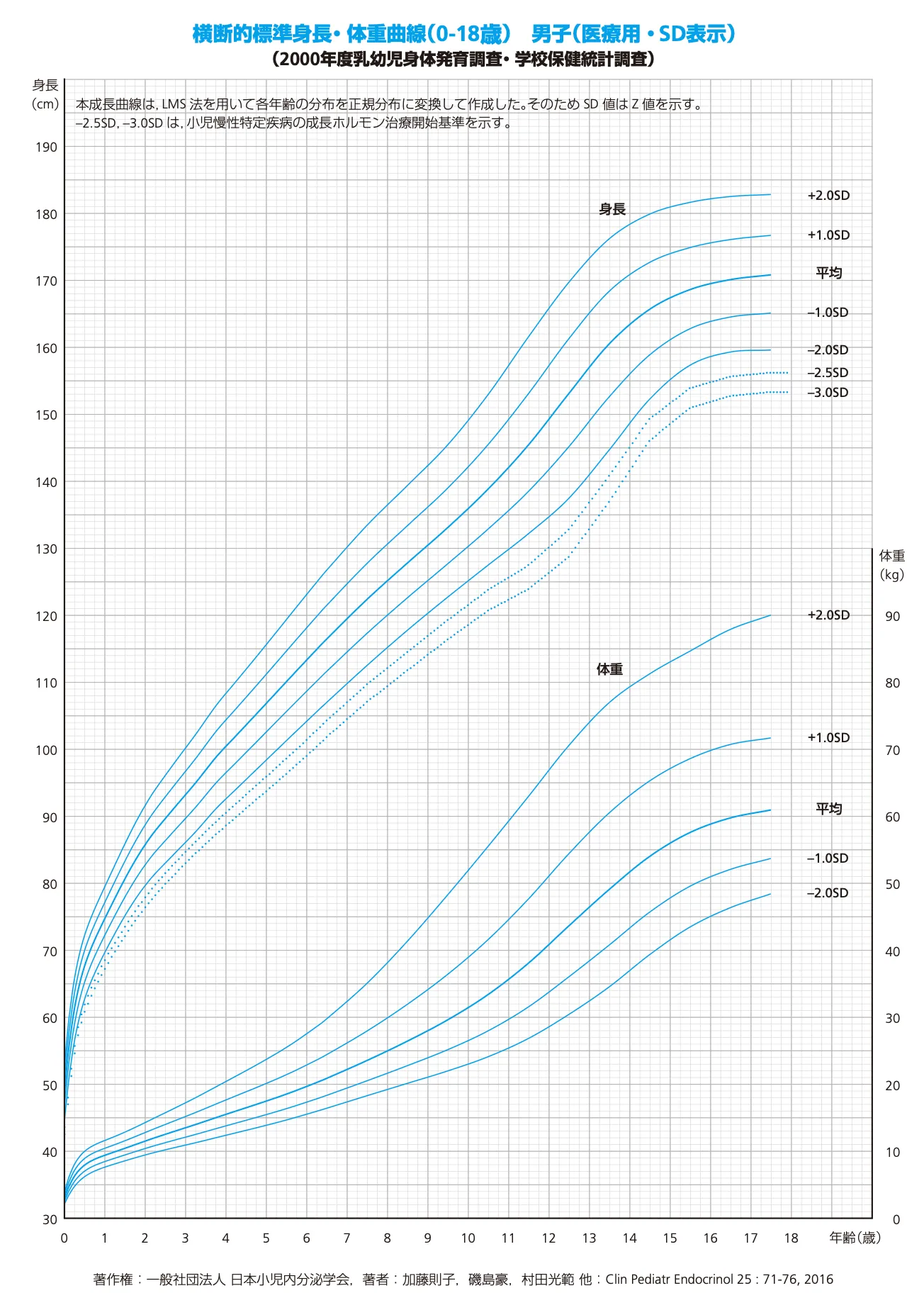
The growth chart shows where the height and weight of children of the same age tend to fall, using a mean line and bands of standard deviation (SD) above and below it. Generally, being within ±2SD is considered standard growth, and falling below −2SD prompts a recommendation to consult a specialist about short stature. In Japan, the baseline comes from survey data collected by the Ministry of Health, Labour and Welfare and the Ministry of Education in 2000.
In practice, what matters most is not the absolute height at any single moment but the trend, whether a child keeps growing along their own curve. You plot the height regularly and watch for any sudden drop or deviation from the line they've been tracing. Following the line rather than the dots is how the growth chart is meant to be used.
As for where we stand, our older son sits around −0.5SD and our younger son right about +1.0SD. Neither is far off the standard, but since we're at it, I'd love for them to fully realize their potential.
Building a Kid's Body Isn't So Different from an Adult's
One thing I learned as I dug into this is that what you do to help a child grow taller isn't all that different from building an adult's body.
Boiled down, it comes to three pillars: a diet with the right nutrition, enough high-quality sleep, and exercise that gives the bones a vertical stimulus.
In what follows, I'll write about what we do for each of these in our household, adding the supporting evidence as I go.
Diet: Protein, Vitamin D, and Zinc
Calcium alone isn't enough to grow bones; nutrients like protein, vitamin D, and zinc are also needed. Protein is the building material for the body, vitamin D helps the gut absorb calcium, and zinc is a mineral involved in growth hormone secretion and cell proliferation. There's also a noted possibility that a zinc deficiency can lead to reduced growth hormone secretion.
So in our house, we keep these three in mind when preparing meals.
For protein, the stars are the homemade chicken ham I make for myself, plus eggs and milk. When that falls short, we supplement with yogurts like Oikos or with protein powder (about once a week). Vitamin D naturally gets covered alongside these. We aim for roughly 60g to 80g of protein per day.
Zinc tends to run short unless you're deliberate about it, so we work some wakame seaweed into a dish every day and slip in natto or nuts now and then to help fill the gap.
Sleep: Lights Out by 21:30, at Least 9 Hours
Sleep is probably the area we go hardest on.
In our home, the kids are always in bed by 21:30, with at least about 9 hours of sleep secured. Watching videos on the iPad or TV wakes the brain up and makes it harder to fall asleep, so we have them wrap up screens by around 20:00. We also keep the gap between bath time and bedtime as short as possible. These are our basic rules (though of course there are days we can't pull it off).
Even so, the kids have their own desires: to wake up early and play Pro Spirits (a baseball game), or to watch videos. I get it completely. So rather than banning things outright, we study together why sleep matters and share that understanding.
There's a reason behind this. There's research showing that children who get longer nighttime sleep tend to be taller.
A large-scale Japanese study (JECS) reported a positive association between nighttime sleep duration at 1.5 years of age and height at age 3. What's interesting is that it wasn't total 24-hour sleep including naps, but only continuous nighttime sleep that showed the association. That fits with the fact that the big bursts of growth hormone secretion happen during consolidated nighttime sleep.
Exercise: Vertical Stimulus
As for exercise, they play baseball until they're exhausted on weekends, so I think the volume is plenty.
On top of that, as a deliberate tweak, we've built several jumping movements into their baseball practice menu, and the whole team works on them together. And for five years now, our family has taken trampoline lessons, which I have a feeling provides exactly that vertical stimulus.
There's evidence behind this "vertical stimulus." In a controlled trial targeting children of short stature (ages 8 to 11) who did jumping exercises three times a week, 50 minutes per session, over 24 weeks, the intervention group grew an average of +4.2cm, well above the +2.07cm in the control group that did nothing. Improvement in bone mineral density at the femoral neck reportedly explained part of this growth. High-impact vertical loading is thought to stimulate bone formation and the growth plates.
Of course, this study targeted children with short stature, so it doesn't necessarily apply directly to our household. Even so, it gives us a push to keep up the jumping and trampolining.
An Aside: Trampoline as an Extracurricular
Let me digress a little.
Like many families, we've had our kids try plenty of extracurricular activities. Among them, trampoline is by far the one I feel was "great."
I clearly feel its effects, especially when it comes to athletic ability, the development of the nervous system, and building core strength. Neither of my sons was particularly athletic to begin with. But as they kept up the trampoline, their cores grew considerably stronger, and now they move steadily well, whether in specialized movements like baseball or in ground-based training like ladder drills.
My impression, from observing them, is that the big factor is having grasped the sense of controlling their bodies in mid-air. They've come to intuitively understand how moving their body produces a given motion, and the gap between the image in their head and the actual movement has narrowed. That's how it looks to me.
Not just for height but as a foundation for movement itself, it's an extracurricular I strongly recommend.
Recommendations
To close, let me introduce the book that kicked off this whole effort, along with the things we use at home.
- The Amazing Way to Grow Taller, Based on Data from 15,000 People: The book that started it all. It lays out what to do, grounded in data.
- Oikos (high-protein yogurt): We serve it as a supplement or snack on days protein runs short. I like adding frozen blueberries to make it a treat.
- The Pro WPI PERFECT PROTEIN: A last resort when we just can't hit the target. Since we give it to the kids, we buy a protein powder with virtually zero additives. It's pricey, but worth it.
- Home trampoline: We've used it for over ten years and it's still going strong. On top of the lessons, we keep a setup at home so they can jump anytime. Our 3-year-old daughter bounces away on it.
Height is largely determined by genetics, but nutrition, sleep, and exercise are factors that genuinely work on the acquired side. I plan to keep supporting my kids as far as we reasonably can, having fun together along the way.
References
Here are links to the evidence mentioned in the article.
- What is a growth chart (standard growth curves and the concept of SD) — School Health Portal
- Not Determined by Genetics Alone: A Child's Height Can Be Grown with Nutrition — Gakken Parenting Map
- Association of Nighttime Sleep Duration at 1.5 Years With Height at 3 Years: The Japan Environment and Children's Study — JCEM
- Effects of 24-week jumping exercise on bone mineral density and linear growth in children with short stature — BMC Sports Science, Medicine and Rehabilitation, 2025






Comments
Share your thoughts or questions. Comments are published after approval.
Write a comment