This post expands on what I'm privately calling the "management plateau problem" — four tweets I wrote on Christmas Eve, now written out with additional context. I'm primarily thinking about organizations built for rapid growth, like startups and new business ventures.
What happens during a stagnation period
Right after launch, you're at the bottom, so the service can only grow. The hard part is sustaining that growth. At some point, you realize the "daily growth" you took for granted was an illusion.
When this happens, management tends to do things like:
- "Have a multi-angle discussion to identify the root cause and potential solutions"
- "Build careful logic and reconstruct a precise plan to make sure nothing is missed"
- "Address organizational issues to restore internal trust"
All of these look right on the surface. But they are inward-facing, and in most cases they are not facing the customer — the thing that actually matters. Every one of these was a mistake I made personally.
Face the pain, not the organization
When confronted with a "management plateau," the tendency is to place heavy emphasis on "good human management" and "good team-building," spending enormous time and emotional energy creating a sense of consensus. But you have to recognize that this is an escape from the real problem.
The reason things have stagnated is not that team management failed — it's that you have failed to identify the customer's pain and solve it. (Incidentally, "stagnation" shows up in KPIs, but "pain" does not. Customers who've given up on a service leave silently without leaving a trace in the logs.)
There is only one solution: restore traction growth. In this kind of situation, the person who hunts down and hits the customer's pain is rarely the strength of the team — it's usually one stubborn, unpopular fanatic. (Someone who says "NO" to meetings, "NO" to sprawling spreadsheets, "NO" to the biased language of the creators — and just keeps grinding through the painful, lonely work of confronting the psychology of the disillusioned customer.) Can you focus exclusively on identifying and removing the pain?
When traction growth returns, the team naturally tends to turn outward again — a phenomenon I've observed repeatedly.
The necessary "unpopular person"
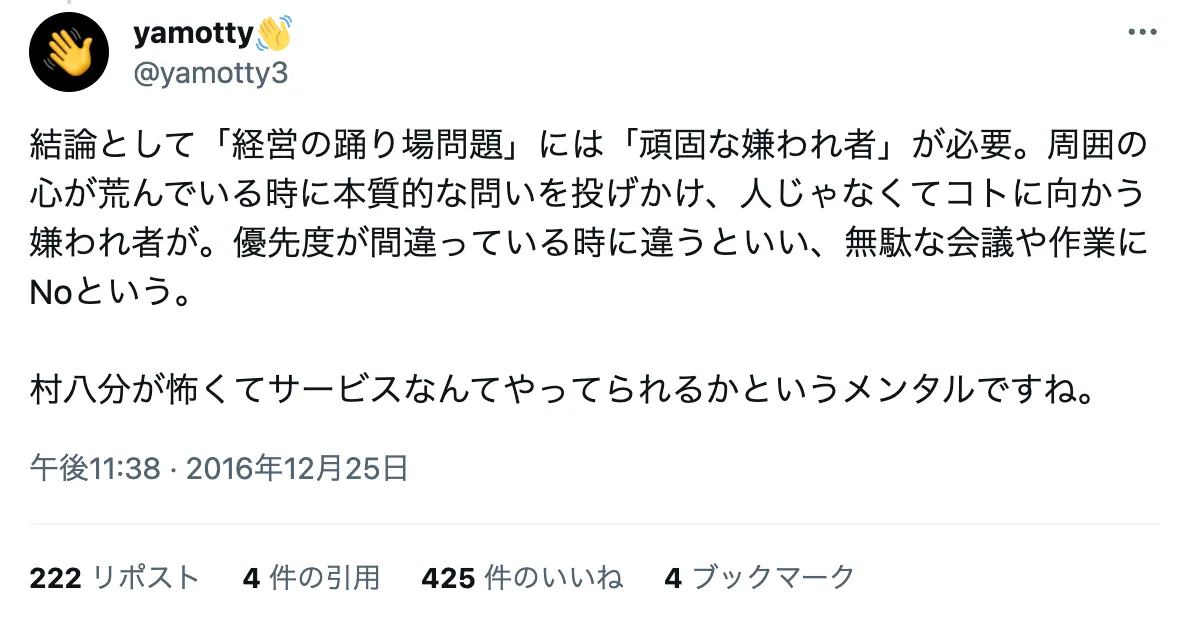
Saying "NO" when everyone around you is doing inward-facing work requires enormous energy. Because the people doing that work feel — from their own perspective — that they're doing it "for the good of the team," and refusing to go along feels like a denial of that. It takes real courage to push back on management when they've turned inward, especially from a lower position.
I think the "product management" theme of this blog is exactly synonymous with continuing to face the customer in this kind of situation. Product manager is just a job title, but product management is an orientation — the posture of "keep facing the product no matter what the current situation is pulling you toward" (or so I believe).
Let's actively choose to be unpopular. A team that builds a product customers don't love has no value.
Postscript
I had written the above rather self-importantly when I came across a post by naoya making essentially the same point.
Also, the entire "plateau problem" is a very familiar story in turnaround cases. One of the clearest illustrations is one of Saegusa's trilogy (a well-known Japanese management book series on corporate transformation), which describes the difficulty of organizational self-renewal almost to the letter.
Because, first of all, no ordinary person can easily change themselves through sheer willpower alone. Without some major event that significantly influences the heart, voluntarily switching one's values, patterns of behavior, likes and dislikes, and sense of risk — breaking habits and suddenly embarking on innovative action — is not something that comes easily. Organizations are the same.




Comments
Share your thoughts or questions. Comments are published after approval.
Write a comment