Since the start of this year, I've been aiming for an average daily active calorie burn of 500 kcal per week — and I've been hitting roughly that target. With a basal metabolic rate of around 1,700 kcal, my total daily energy expenditure lands at about 2,200 kcal.
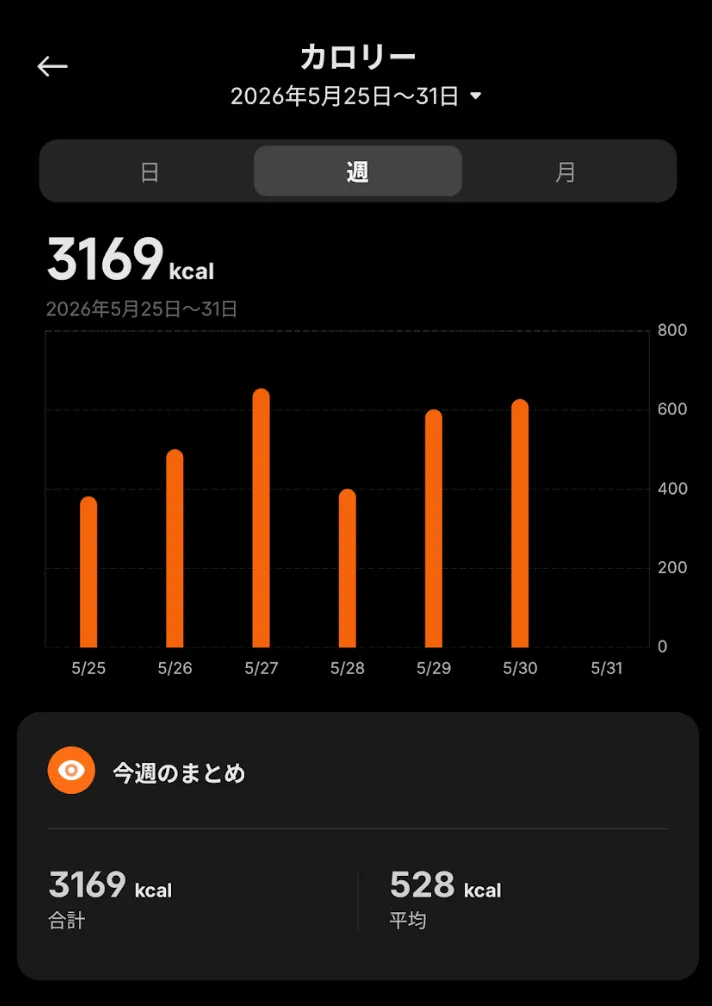
Recent active calorie trends
I came across a post somewhere about a friend of mine named udon, who now lives in Canada and has apparently become a total fitness addict since moving there — apparently aiming for an average of 700 kcal burned per day.
700 kcal is an impressively high number, and honestly, the 500 kcal I'm targeting is also pretty ambitious — at least for a middle-aged white-collar worker.
Looking back at my smartwatch data from a few years ago, my daily average was around 350 kcal. Compared to that, my recent stats represent an increase of about 150 kcal per day — a jump of over 40%.
As you can see in the chart above, there's quite a bit of variance in the daily numbers. On weekends, I often burn around 700 kcal in a day.
For the past six years or so, my main form of exercise has been strength training. In terms of calorie burn, though, weight training is surprisingly modest — usually less than 100 kcal per session.
More recently, I've added cardio like running and swimming to the mix. On weekends, I spend almost the entire day moving around as I accompany my son to baseball practices and games.
Weekends in particular tend to rack up big numbers: I'll do my usual morning strength training and a run before heading out to morning and afternoon baseball sessions. The calorie burn adds up fast.
Cardio really does burn a lot — a single run can knock out around 400 kcal in one shot.
That said, as a desk worker who wants to maintain both strength training and cardio on weekdays, the heat lately has made running feel less appealing. To save time and avoid the heat, I've been slipping away at lunch to swim at a nearby pool for about 30 minutes.
Here's an interesting wrinkle, though: my body weight has actually increased by about 3 kg over the past two years. It's obvious that my caloric intake is outpacing expenditure, but the strange part is that I haven't dramatically changed my diet — I've been keeping fat intake moderate and eating around 2,200 kcal a day. Meanwhile, my maxes on the Big 3 lifts have been climbing steadily, approaching my all-time peak.
My hypothesis: the increased training volume has triggered muscle memory, and my muscle mass is returning.
The Mechanism of Muscle Memory
I was curious about this, so I dug into some recent journal literature on muscle memory.
There are two main mechanisms. The first is myonuclear retention. When muscles grow, satellite cells donate nuclei to muscle fibers, increasing the total nuclear count. These nuclei act as protein synthesis factories. The crucial point: even when you stop training and muscles atrophy, those myonuclei don't disappear — they stick around.
In a study by Professor Gundersen and colleagues at the University of Oslo, researchers used atmospheric radiocarbon (¹⁴C) from nuclear bomb tests to measure the average lifespan of human myonuclei. The result: 15.1 years. The cellular memory of past training may literally persist at the cellular level for over 15 years.
The second mechanism is epigenetic memory. A 2018 collaborative study from the UK found that resistance training caused changes in DNA methylation patterns at more than 21,000 sites, and even after three months of detraining, 3,854 of those changes remained. These alterations are linked to key pathways for protein synthesis and can be interpreted as a kind of gene-level "readiness to resume muscle hypertrophy."
That said, this is far from a settled debate. A 2022 meta-analysis concluded that myonuclei tend to be lost in humans, and a 2024 study offered evidence to the contrary — so the discussion is still ongoing.
Still, it's hard for me to believe that the myonuclei I built up through over a decade of training have simply vanished. My theory is that the sharp increase in activity this year — more cardio and baseball — has provided new stimuli that the retained myonuclei are responding to quickly, accelerating muscle regrowth.
The fact that my weight is up but my body fat doesn't feel any different suggests that body recomposition might be happening: muscle going up while fat comes down. At least, that's the positive spin I'm choosing to hold onto.
On a related note, I've been drinking protein shakes less frequently lately — so when I do have one, I want quality. I've been using PERCECT PROTEIN, which is lactose-free and contains no artificial sweeteners or additives, making it easy to give to kids too.
References
- Muscle memory and a new cellular model for muscle atrophy and hypertrophy — Gundersen (2016, Journal of Experimental Biology)
- Skeletal Muscle Possesses an Epigenetic Memory of Exercise — Seaborne et al. (2018, Scientific Data)
- Myonuclear permanence in skeletal muscle memory: a systematic review — Rahmati et al. (2022, Journal of Cachexia, Sarcopenia and Muscle)
- Muscle memory in humans: evidence for myonuclear permanence — Cumming et al. (2024, Journal of Physiology)
- Skeletal muscle memory (2023, American Journal of Physiology-Cell Physiology)
Comments
Share your thoughts or questions. Comments are published after approval.
Write a comment