I've been using a Xiaomi Smart Band for over three years. Mine is the 7th generation, so it's a bit old at this point, but it's cheap, durable, has great battery life, and the sleep tracking accuracy is solid enough for my needs.
I've been using it to analyze my sleep and make tweaks over time. Here's what my recent data looks like.
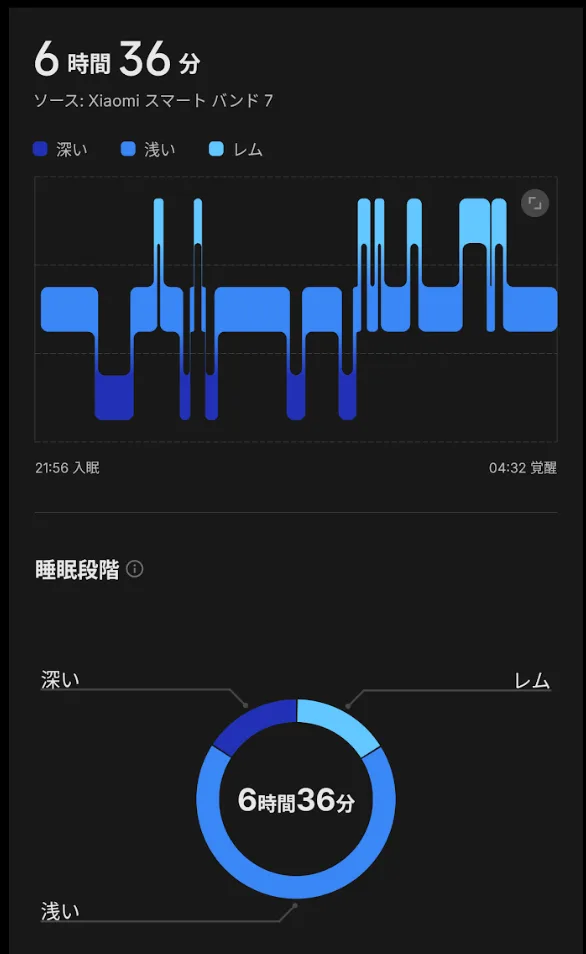
The main issue: too little deep sleep, too much light sleep. Even when I extend my total sleep time, deep sleep barely budges — it's been hovering around 17% on average.
My goal was to push that up by about 5 percentage points to reach 22% or above, which is considered a healthy level.
I Asked AI for Advice
I copied my Xiaomi data straight into a chat and asked for suggestions. Here's what came back:
- Block blue light: stay off screens 1–2 hours before bed
- Adjust lighting: switch to warm-toned light in the evening to promote melatonin production
- Time your bath: 15 minutes in 38–40°C water, 90 minutes before bed
- Evening static stretching: stimulate the parasympathetic nervous system for better recovery
- Finish dinner at least 3 hours before bed
Honestly, I'm already doing all of this — have been for years.
These are the first-level interventions you run into when you start looking into sleep improvement. I implemented them a few years ago, and I've hit the point of diminishing returns. (The wildcard of sleeping next to my 3-year-old daughter and her moods is unfortunately beyond my control.)
To push further, I decided I needed to turn to tools and supplements.
What Actually Worked
Here are the things that showed real improvement — both in how I felt and in the numbers.
1. Shakti Mat
I've been using one since last year.
Whether or not I use it before bed has a clear impact on how quickly I fall asleep and how likely I am to get deep sleep. Earlier this year I ran an informal A/B test — tracking nights with and without it — and the difference was obvious. So far, this has been the single most effective thing I've tried.
The idea is that the countless spikes pressing into your back stimulate the parasympathetic nervous system and guide your body into a state of deep relaxation. I usually lie on it naked for about 20 minutes before going to sleep.
2. Kewpie Kowa Healing
I take 2 tablets before bed.
I haven't been able to measure the effect precisely in numbers, but when I take a week off and then restart, the difference in how I feel the next morning is unmistakable. I do notice that continuous use leads to some tolerance, so I try to save it for when I really want a good night's sleep.
3. Magnesium
Clinical trials have confirmed that magnesium can improve sleep quality through two pathways: inhibiting neural excitation via NMDA receptors and promoting melatonin production. It's generally positioned as a mineral that relaxes the nervous system and muscles to encourage restful sleep.
During high-intensity exercise, magnesium losses increase through both sweat and urine, with some research suggesting requirements may rise by up to 20%. I suspect I've been chronically deficient, so I take it daily. The subjective effect isn't so much about deeper sleep per se, but that I tend to enter deep sleep sooner after falling asleep.
It's not stocked at my local drugstore, so I order it from Amazon.
4. Glycine + Theanine
I've been taking this daily for about a month.
L-theanine's ability to shorten sleep onset latency and improve subjective sleep quality was confirmed in a 2025 meta-analysis of 19 RCTs involving 897 participants. Glycine (3g before bed) has been shown in polysomnography studies to lower core body temperature and accelerate the transition into slow-wave (deep) sleep. Combining the two is said to address both how easily you fall asleep and how deep that sleep gets.
Fine Glycine+ Glycine 3000 & Theanine 200
Results
Since incorporating these, I've had days where deep sleep exceeded 20%. It feels like I'm actually making progress on the problem I set out to solve.
I haven't quite hit my 5 percentage point goal yet, but the direction is right. If my daughter keeps sleeping peacefully, I expect the numbers to stabilize a bit more.
References
Leaving evidence links for the supplements mentioned above:
- The effects of L-theanine consumption on sleep outcomes: A systematic review and meta-analysis — PubMed, 2025
- New therapeutic strategy for amino acid medicine: glycine improves the quality of sleep — PubMed, 2012
- The sleep-promoting and hypothermic effects of glycine are mediated by NMDA receptors in the suprachiasmatic nucleus — PubMed, 2015
- Update on the relationship between magnesium and exercise — PubMed, 2006
- The effect of magnesium supplementation on primary insomnia in elderly — PubMed, 2012
Comments
Share your thoughts or questions. Comments are published after approval.
いつも楽しく拝読しています。 睡眠をガチるの記事を読んで、yamottyさんが「効果があったもの」としてあげられていたものを全て取り入れて二週間ほどが経過しました。 まだ日によりますが、睡眠スコアが改善する日もあり、効果を実感しています。教えていただきありがとうございました。
なんと、全てお試しいただいたんですね!効果があったようで嬉しいです😊 最近は寝る前のスマホを遠ざけるために目覚ましもスマートウォッチに切り替えまして、そちらも結構効果があるきがします。
Write a comment