It's been about 2.5 years since we founded 10X. Some recent conversations have made me want to write about co-founders in my own words.
10X has a co-founder named Ishikawa — a software engineer by background. This post is written with him as the model.
If you're reading this and you're about to tackle a big project, you have a potential co-founder in mind, and you have some hesitation — I hope you can share this article and have a frank conversation about the specific points it raises.
Is a co-founder important?
"Indispensable" is the only word I have.
This is based purely on my own experience, but I place co-founder choice above product, market, and timing in order of importance.
A First Round Capital study found that startups with co-founders performed 163% better than solo-founder startups, and achieved 25% higher valuations.
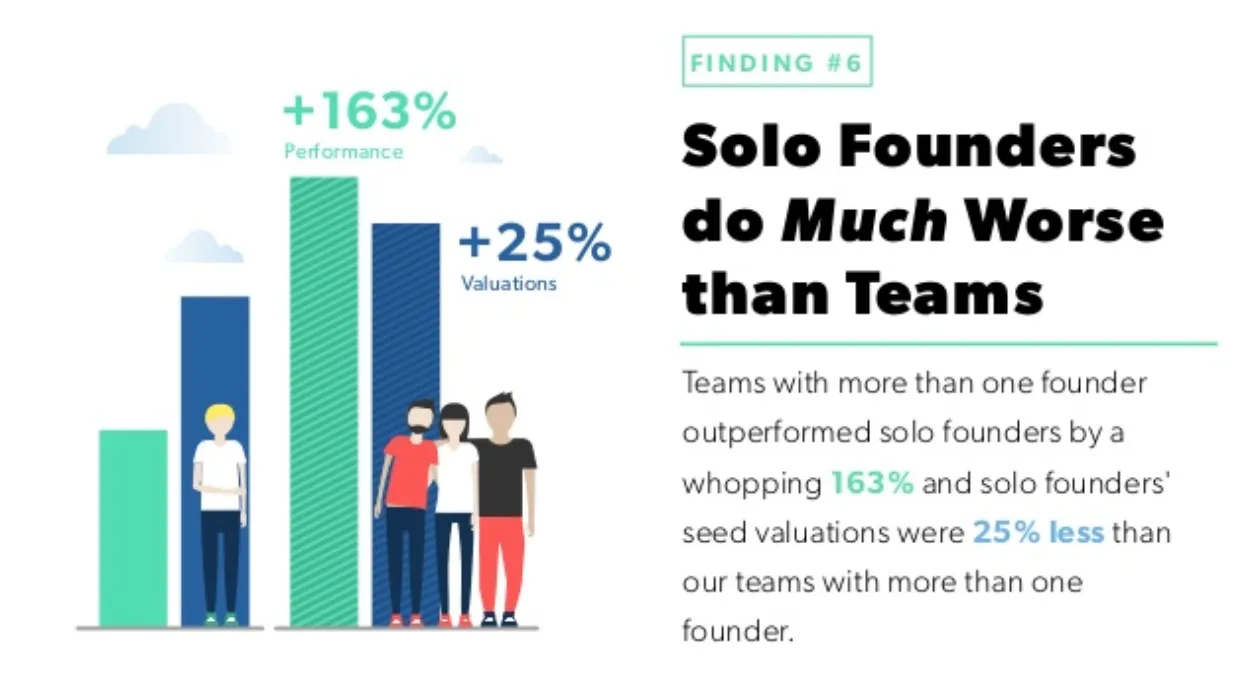
But those facts come several steps down the road. What I value more, before any of that, is what a co-founder means on day one:
- The first person to say yes when everyone else is skeptical
- The first person working alongside you
- The first outsider who bets on you
- The person who notices your mistakes and tells you
That role as a first companion on the journey has a meaning that I can't fully put into words.
Ishikawa is one of the people I respect most in my life, and one of the people who has influenced me most.
Making the commitment explicit
Before and right after founding, the first thing we did was articulate our expectations as explicit commitments.
I asked for someone who is both a specialist and an executive — and Ishikawa agreed to that, and I believe we've both kept it. That's why he holds the title of CTO and also sits on the board.
The commitment breaks into four components.
1. Being willing to shift roles repeatedly, and learn what each new role requires
A founder's role changes dramatically as the team grows and the business evolves. When those changes come is hard to predict — the role itself contains irreducible uncertainty. This is fundamentally different from a "job."
The one thing that's always clear: whatever is most blocking the business, we have to be the ones to solve it.
Not "what am I already good at" but "what is needed next" — and then figuring out how to get there. That animal-like resourcefulness.
Whether someone has that quality isn't visible until you've actually worked through something together.
When I first knew Ishikawa at our previous company, he was a recognized excellent mobile engineer. At the same time, he always had sharp views on user experience and organization — an obvious belief that "delivering something good requires getting a lot of things right."
Since founding, he's continued learning at pace. Today he conducts user interviews himself, designs CRM strategies, does deep client analysis, manages product, and runs recruiting. Still a top-tier engineer, and simultaneously operating far beyond that frame. I attribute it to a fierce commitment to making the business succeed.
2. Personal goals aligned with company goals
That fierce commitment doesn't arise spontaneously. It happens because it has to.
Where does it come from? From the alignment between what the project is trying to achieve and what the person personally wants.
Structure is everything.
And each person has multiple personal goals:
Help build someone else's vision? Or build your own product and your own vision?
Work with people gathered around someone else's values? Or work with people who share your values deeply?
Follow someone else's decisions? Or make decisions yourself?
Work steadily and earn a reliable income? Or take risk and pursue an order-of-magnitude different outcome?
Starting a startup means choosing the latter on all of these. At minimum, a co-founder needs to be clear that the "latter" path is what they genuinely want for their own life.
What I did when I asked Ishikawa to co-found was to lay out the risks and expected returns on each of these dimensions clearly, and make the comparison easy. Then I left the decision to him. He said yes, and we started together.
Now we apply this to every full-time hire: we design our organization and governance to create conditions where company goals and personal goals align.
3. Complementary skills — each bringing what the other lacks
1 + 1 = 2 is math. In work, actually achieving 1 + 1 = 2 — each person performing at their full level and the combination adding — is genuinely hard.
To get there, you need a co-founder with different strengths who is aiming in the same direction.
I brought product management experience and startup experience. Ishikawa brought the ability to hold complex specs in his head and build from design to implementation. We were good complements.
Complementary skills have another benefit: they accelerate mutual learning.
From the earliest days, I did rough UI design and Ishikawa refined it during implementation — effectively sharing a UI design role between us.
My skills at the time were honestly pretty rough. I had limited understanding of system architecture, so I was producing UIs that were functional but embarrassingly ugly. But feedback like "iOS guidelines say this should work differently" or "this is processed client-side so there's no wait time" — grounded in his expertise — made my designs dramatically better.
4. Being the first person you consult
I mentioned the value of a "first companion" above. There's one more dimension: being able to safely disagree.
Ishikawa and I often diverge on the "how." I've come to understand that when we disagree, it's almost always because both of us are holding something important that hasn't been communicated clearly yet.
Without a close relationship where you can give each other granular feedback, those hidden concerns stay hidden — and you make decisions that unnecessarily sacrifice something. But most apparent trade-offs can actually be resolved with better design. They just look like trade-offs because neither person can see the full picture alone.
Having a "first consultant" makes it much easier to avoid false trade-offs.
Building a co-founder-like relationship with employees
Everything about how I build the co-founder relationship is directly applicable to building relationships with employees.
Or more precisely: you can only build a team that's an extension of how you approached the co-founder relationship.
Be explicit about expectations. Explain the risks and returns. Design governance. Learn what the other person doesn't know and vice versa. Confirm goal alignment. Consult each other often and specifically.
None of this is surprising. But the orientation you bring to the first day with a co-founder sets the pattern for everything else.
Co-founding is often compared to marriage — but it's different
I've been with my partner for nearly ten years. She and Ishikawa do not affect me the same way at all. If anything, the opposite.
The "family partner" dimension of being an entrepreneur deserves its own post — I won't go into it here. But I want to be clear: in my personal experience, they are completely different relationships.
Closing: the people who gave me perspective on co-founders
Before founding, I talked to a handful of people I respected. The model that was most useful for thinking about co-founders was the relationship between Otani-san and Shimada-san, the co-founders of Connehito (a Japanese parenting community app).
The two of them maintained a complementary relationship for years — CEO and CTO, comedian and straight man, accelerator and brake. They were a nearby example of something working.
Right before I founded 10X, Otani-san gave me this advice:
"When I brought in my CTO, I made it explicit that I wanted him to be an executive, not just an engineer. That clarity meant we could say difficult things to each other and that we naturally became each other's first call when something was hard. We aren't particularly close outside of work. But in the pursuit of a big goal, that turned out to be the most important thing."
That one sentence became the seed of how I think about co-founders.
If you're figuring this out, it helps to go talk to a successful co-founder pair — not just to read about it.
Postscript: Otani-san and Shimada-san both eventually left Connehito — and immediately started planning their next venture together, including a world trip to brainstorm ideas side by side. Guess they're close after all.


Comments
Share your thoughts or questions. Comments are published after approval.
Write a comment