I believe CEOs face a structural problem with feedback loops: ultimate accountability for results and the difficulty of receiving candid feedback from reports and investors means CEOs tend to get feedback late, if at all. To counter this, I decided to run a structured CEO evaluation — designed to surface issues with me personally and with the organization.
Survey design
We targeted the 13 members who had joined by July 2020. Our investors at DCM Ventures — Hara-san and Sarumaru-san — conducted individual 1-on-1 interviews with each person. (Sarumaru-san wrote about the methodology on his note if you want details.)
I designed the survey methodology by learning from SmartHR CEO Miyata-san, who runs a similar CEO evaluation process at SmartHR (a leading HR software company in Japan). DCM created their own scoring rubric and produced the final report.
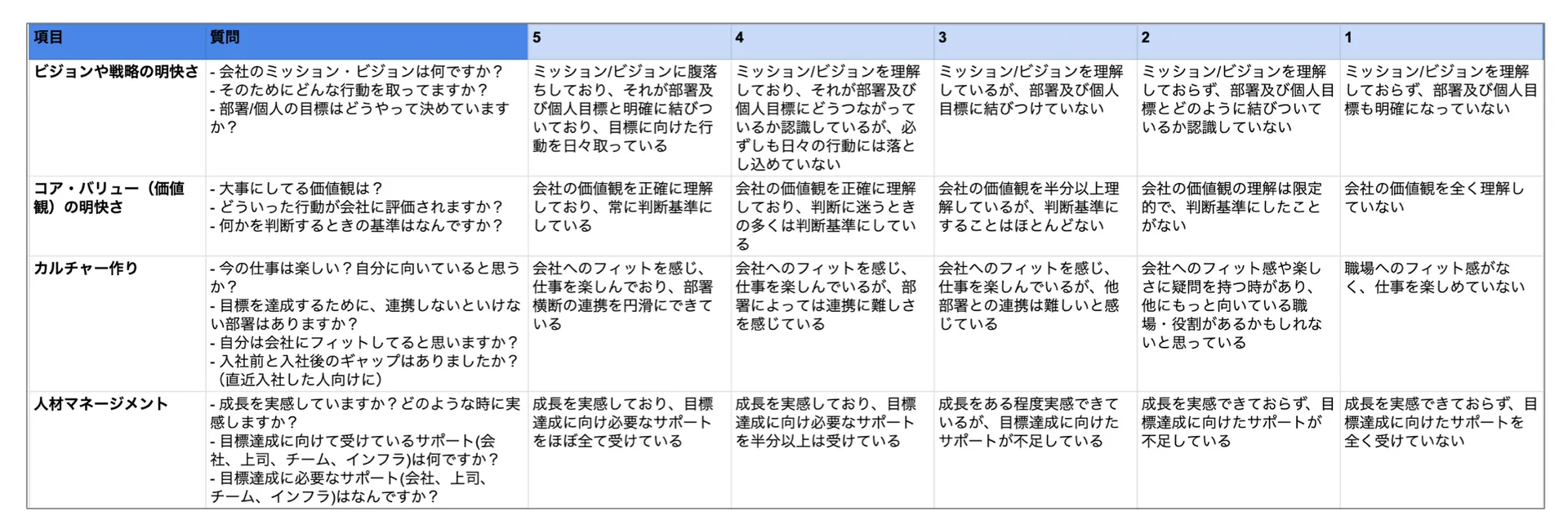
Mid-survey adjustment
As the interviews progressed, DCM noted that the original question set wasn't surfacing all the relevant issues for a company like 10X. Starting from respondent N=9, they added three custom questions:
- Describe the current CEO in three keywords
- Where does the current CEO rank among all leaders you've encountered? (Top X%)
- What would it take to reach the top 1%?
Report results
DCM abstracted the individual interview responses into two categories: "current state from what we observed" and "potential future challenges (not necessarily present today)." Below I share each section of the report, along with my own reactions.
1 / Clarity of values: Avg. 4.92 (Max: 5, Min: 4)
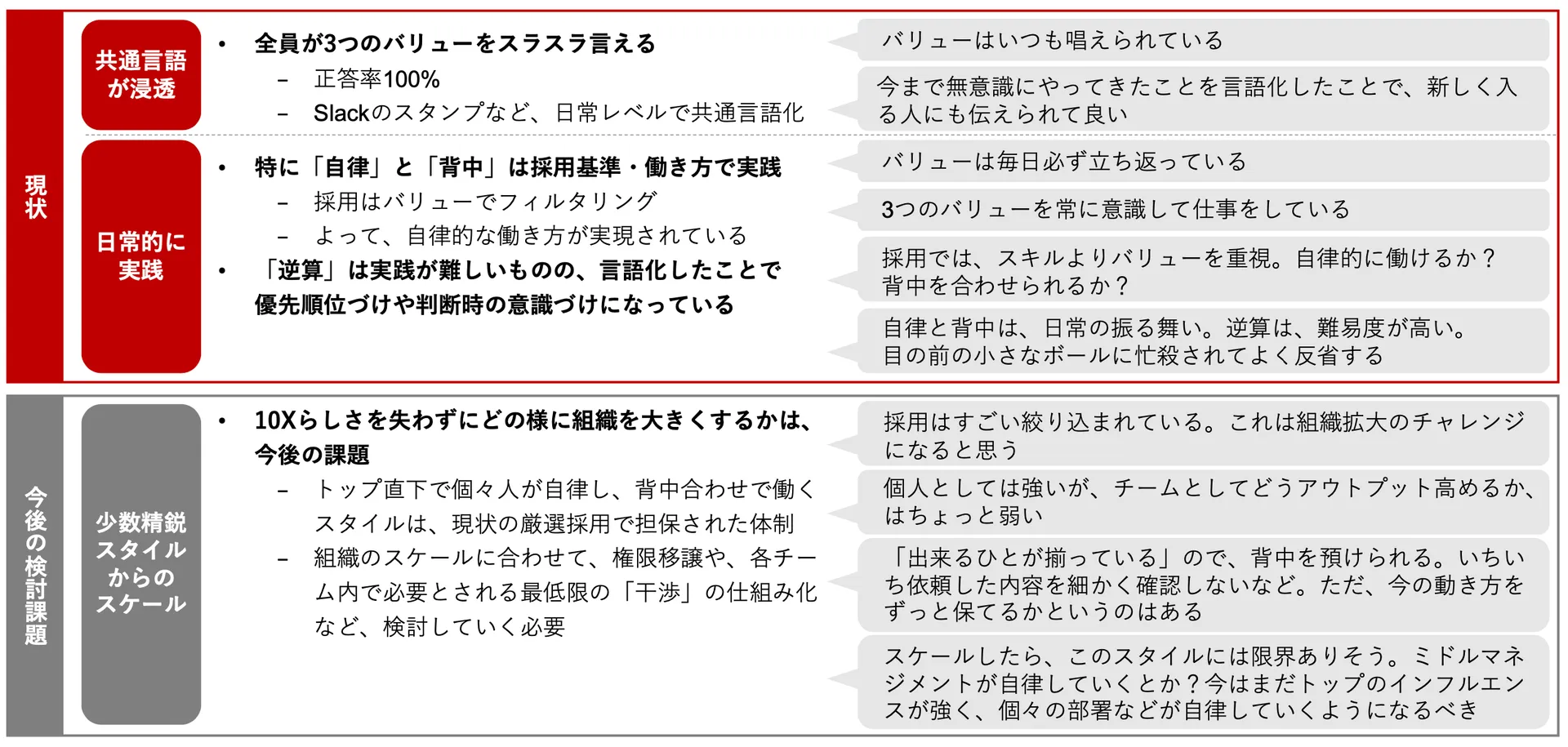
We implemented our three company values in April 2020. Penetration and practice of "Be autonomous" and "Back to back" in particular were extremely high — DCM's feedback was "as the scores clearly show, this couldn't be better." On "Work back from 10x," everyone is keeping it in mind and acting on it, even though it's the hardest to fully embody.
The fact that values are deeply embedded in both hiring and how we work means we've built something that actually works in practice. This has made the company meaningfully stronger.
On the other hand, a concern that came up here — "scalability as headcount grows" — reappears throughout the other sections, and it's something I'm actively thinking about.
2 / Clarity of vision: Avg. 3.88 (Max: 5, Min: 2)
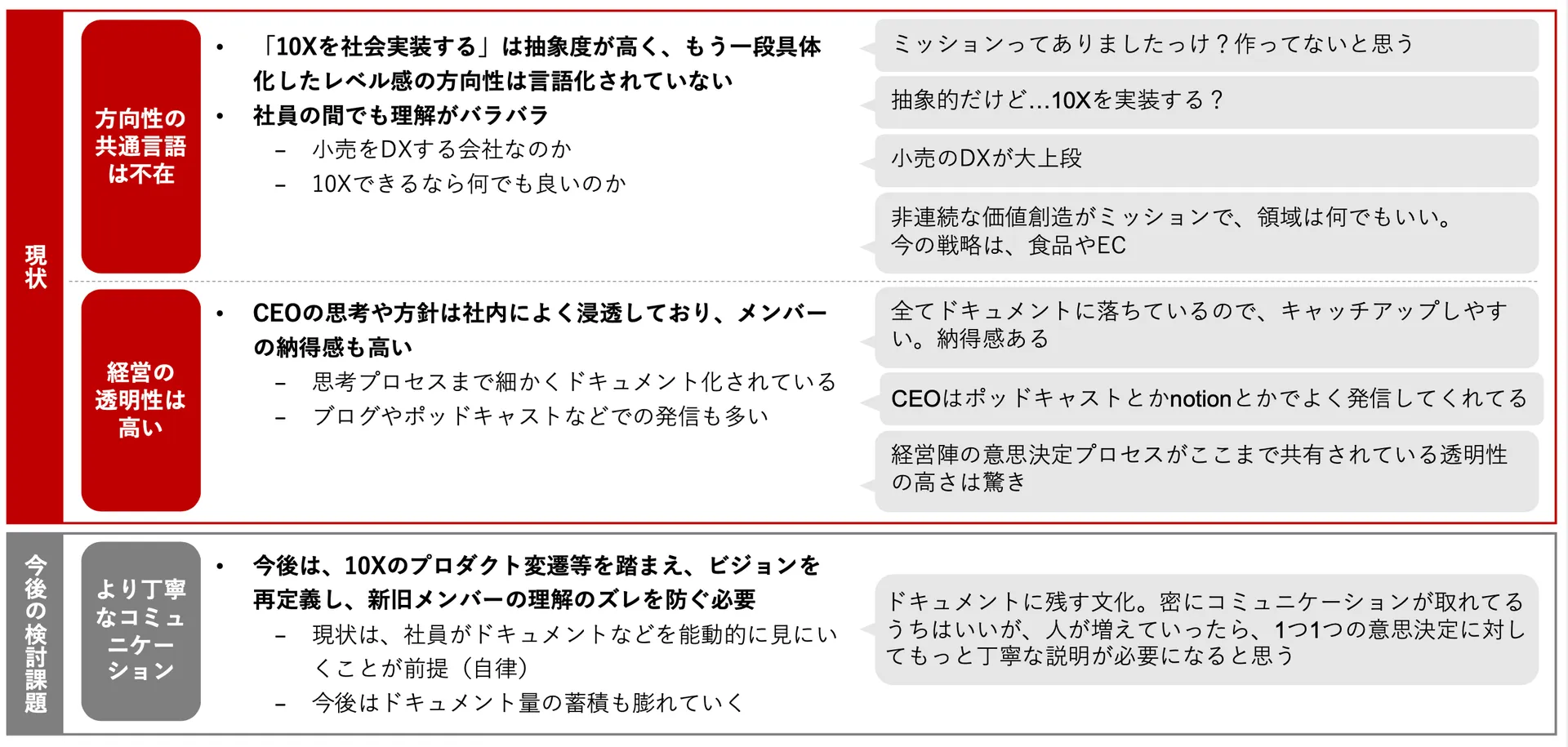
Here's an honest admission: 10X doesn't have a "vision" in the traditional sense. Our mission is "create 10x." Comments like "does a vision even exist," "why this, not 'make retail 10x'?'" made clear that what we do have isn't penetrating well. This is my problem to solve, and I want to act on it quickly.
My reasoning: the company name itself is "what we want to achieve." Defining a narrow frame might actually work against our goal of continuous discontinuous change across domains. But I can see that without a clearly communicated vision, the openness we've built through documentation doesn't reach its full potential.
The potential future issue: "what happens when headcount grows to a point where documents alone can't solve it?" — also something I'll address below.
(For what it's worth, something like "make retail 10x" would be a product vision, not a company vision. Company vision should live at a higher level of abstraction.)
3 / Culture building: Avg. 4.81 (Max: 5, Min: 4)
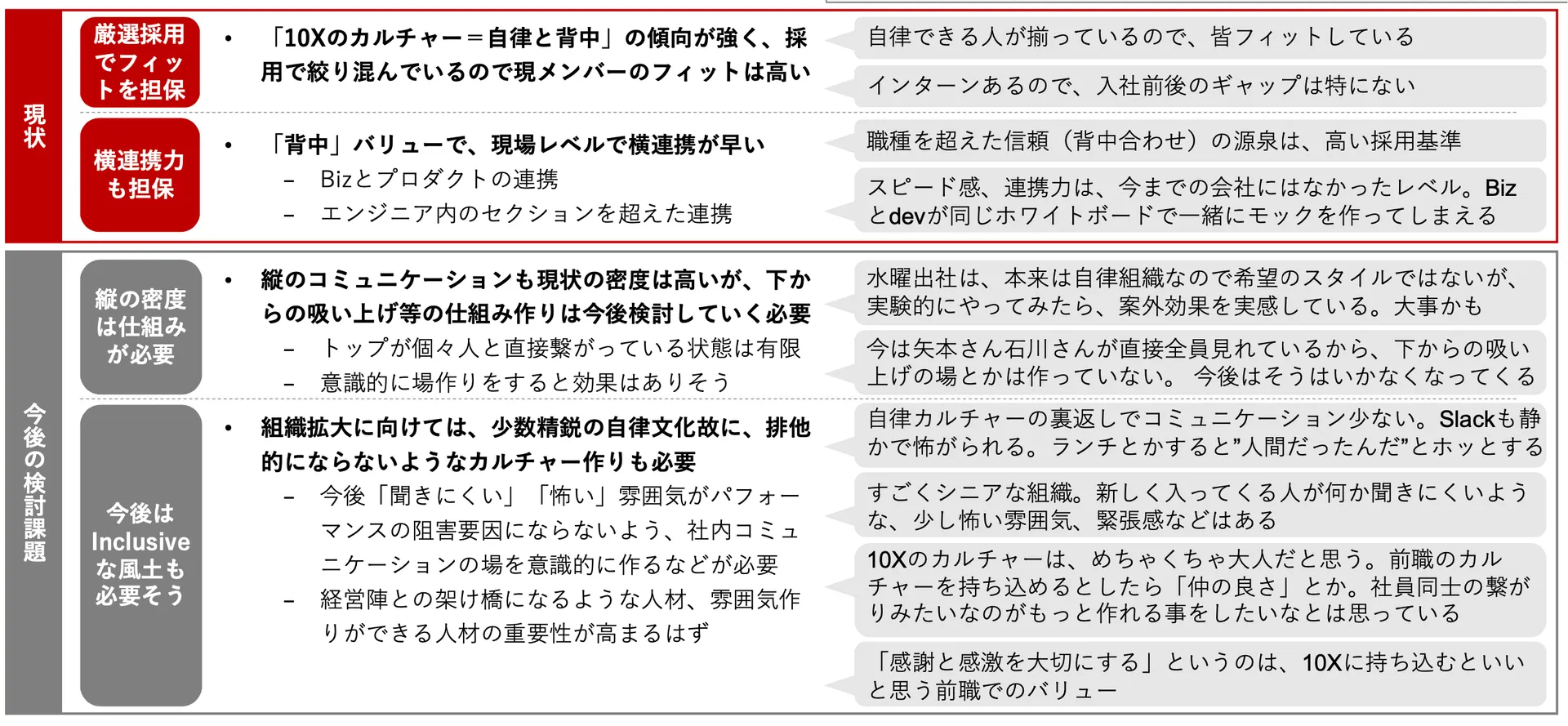
Right now, "culture" largely means "how well values are being lived out" — and that's strong. The two future challenges flagged were: "insufficient upward feedback" and "inclusivity."
On inclusivity: what does that state actually look like? My working definition:
- Psychological onboarding is easy, not just functional onboarding
- People can resolve their own hesitations
- There's a felt sense of mutual acceptance and connection
- This coexists with "autonomy" and the inherent tension of a startup environment
That's not the same as "everyone is friends." It's a harder, more specific thing. And creating that environment is both my personal challenge and the whole organization's challenge.
4 / People management: Avg. 3.58 (Max: 4.5, Min: 3)
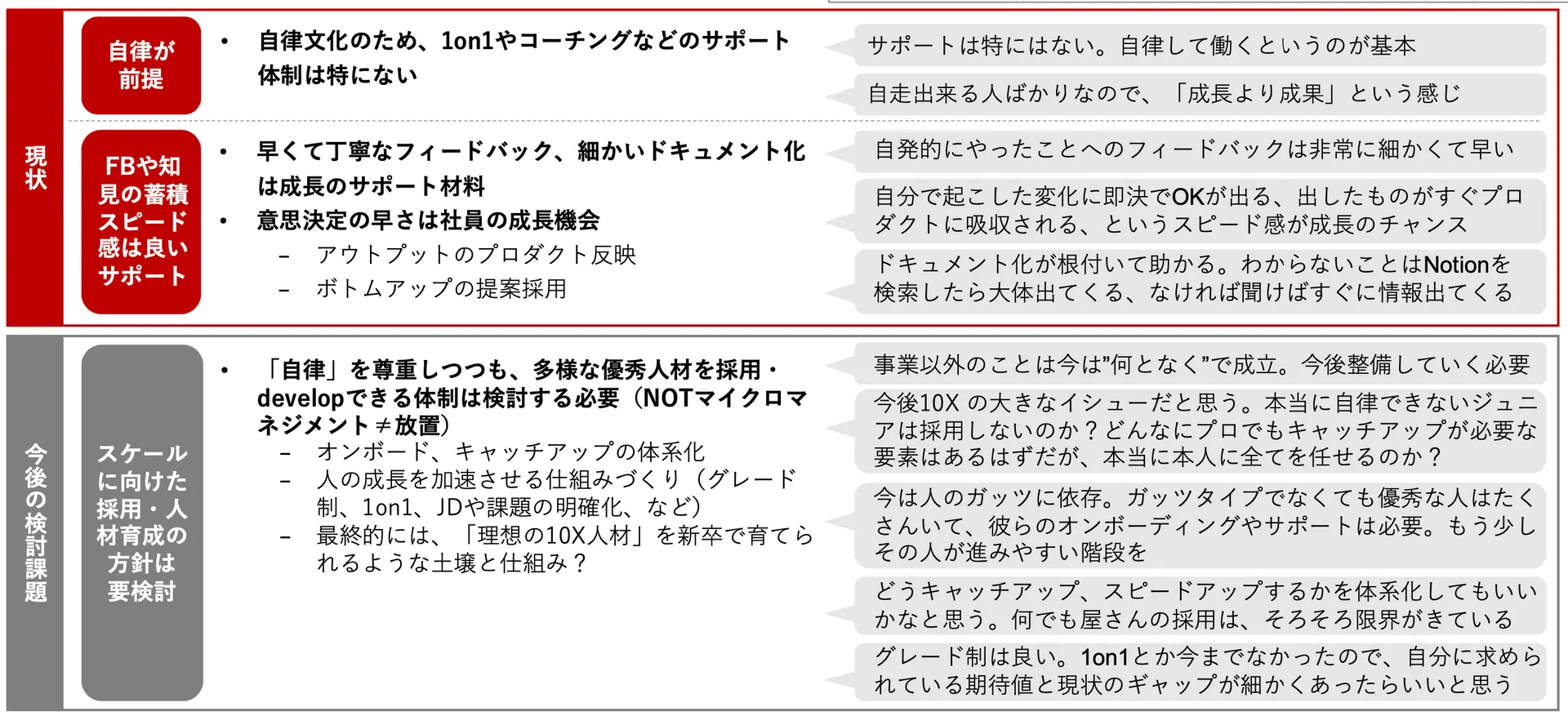
DCM noted separately: "This survey design naturally produces low scores for companies that don't do 1-on-1s. The fastest way to improve the score is to do 1-on-1s — but whether that's the best approach for employee development at your stage is worth thinking through." I agree with that framing.
Some comments here said "leadership doesn't gather feedback from below"; others said the opposite. Both are true, in different ways.
This reflects two deliberate choices: (1) building organizational management infrastructure optimized for scale (document-centric, high leverage) and (2) intentionally not doing things yet that would be valuable later, like formalized career development support or hierarchical clarity.
Both of these choices connect to a hiring strategy focused on G3+ talent (people who can work independently at a senior level). I believe this is better for the current phase — but I also know that long-term, I need to develop deeper diversity and capability development. The challenge is timing the transition correctly and not getting the sequence wrong.
5 / Three keywords to describe the current CEO
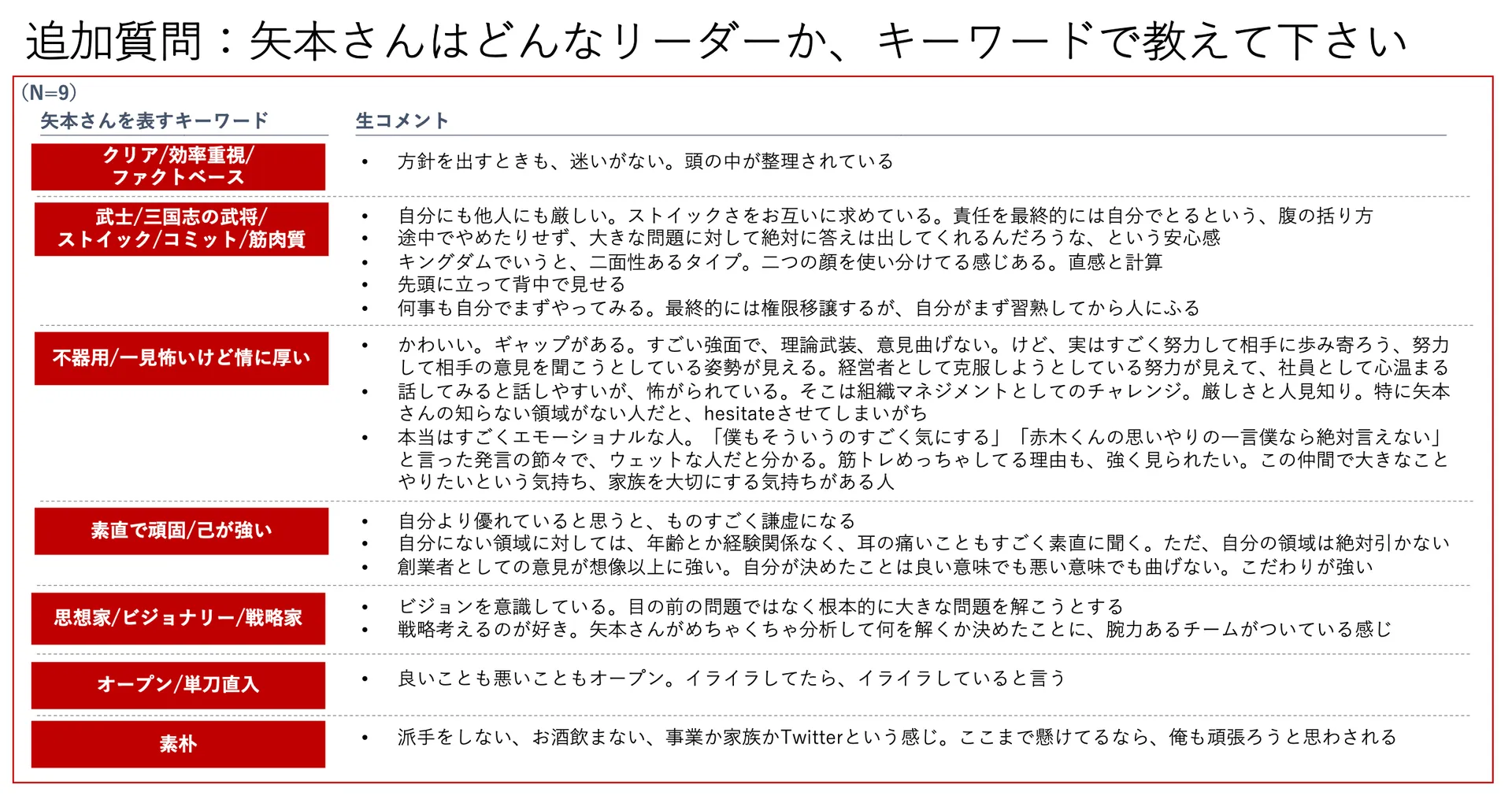
In short: almost no gap between how others see me and how I see myself. I'm not especially skilled socially, I don't say clever things, and I'm slow to change my position without a well-reasoned argument. Knowing that the external view aligns with my self-understanding — I take that as a positive sign.
I don't have a clean answer to "what is leadership." What I do have is a personality and set of values that are deeply mine and hard to change. The frame I work with: "how can I most effectively leverage what I am to have a positive impact on the world and on the team?"
My wife's reaction when I showed her the results: "Everyone really knows you well, don't they." (She laughed.)
I want to make my strengths even stronger, and build a team that compensates for my weaknesses. The reason everyone currently on this team is here is precisely that they bring strengths I don't have.
(Side note: DCM mentioned that when surveying startup alumni about why they left, "the CEO wasn't focused on the business and company" comes up frequently. Apparently directness — just being focused — is "easy to miss but critically important.")
6 / Where does the current CEO rank among all leaders you've encountered? Avg. 8.3%
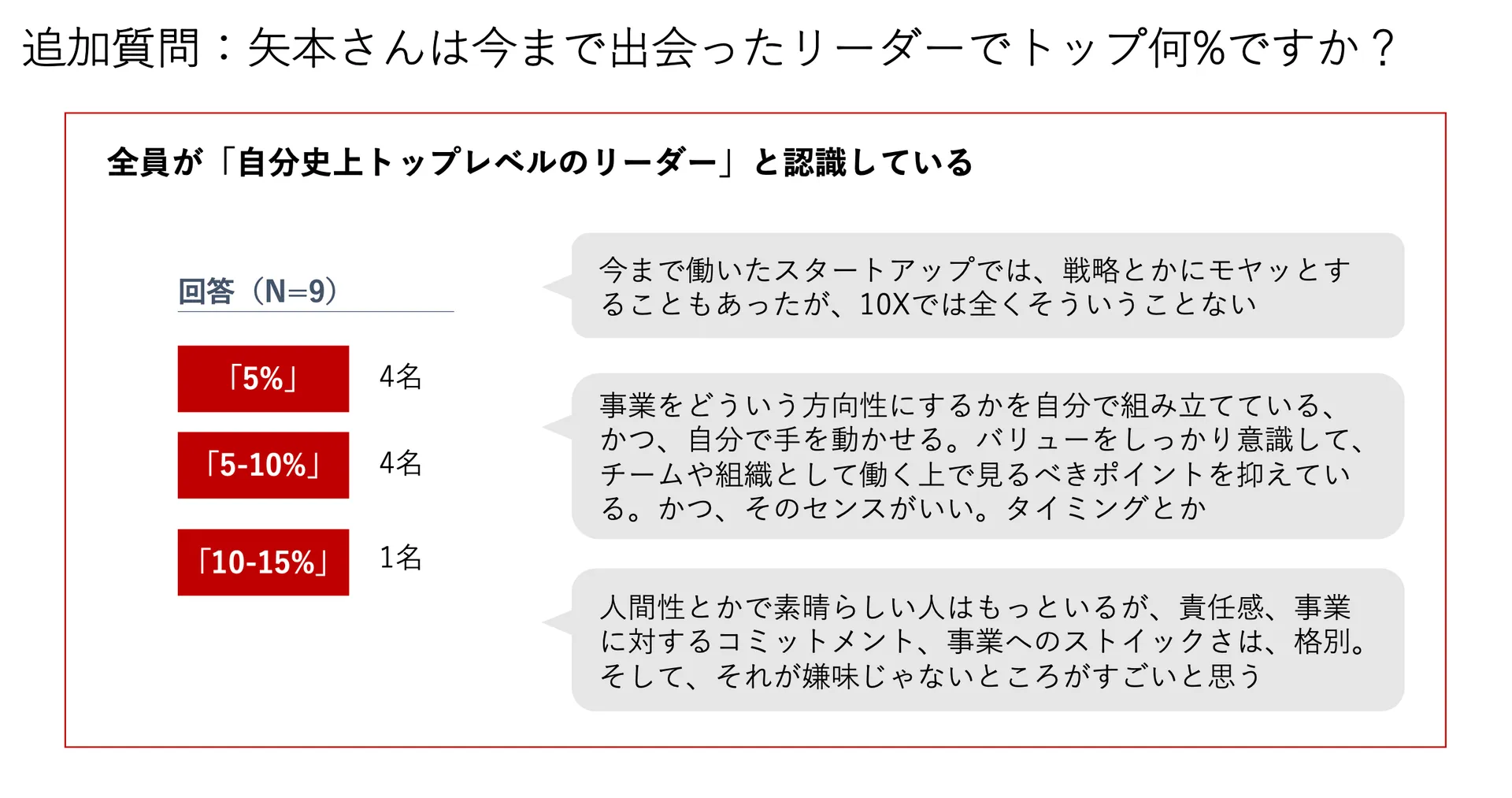
DCM's comment: "An excellent result. Focus on how to maintain this — and on what it would take to reach the top 1%."
And their note that "there are many people who are exceptional as human beings" — absolutely true.
I'm not naturally charismatic. I don't draw people easily through personality or words. This is something I wrestle with. But I've made peace with it and focus on doing what I should do, with uncommon intensity.
Building a team that compensates for what I lack — that's the most important thing going forward.
7 / What would it take to reach the top 1%?
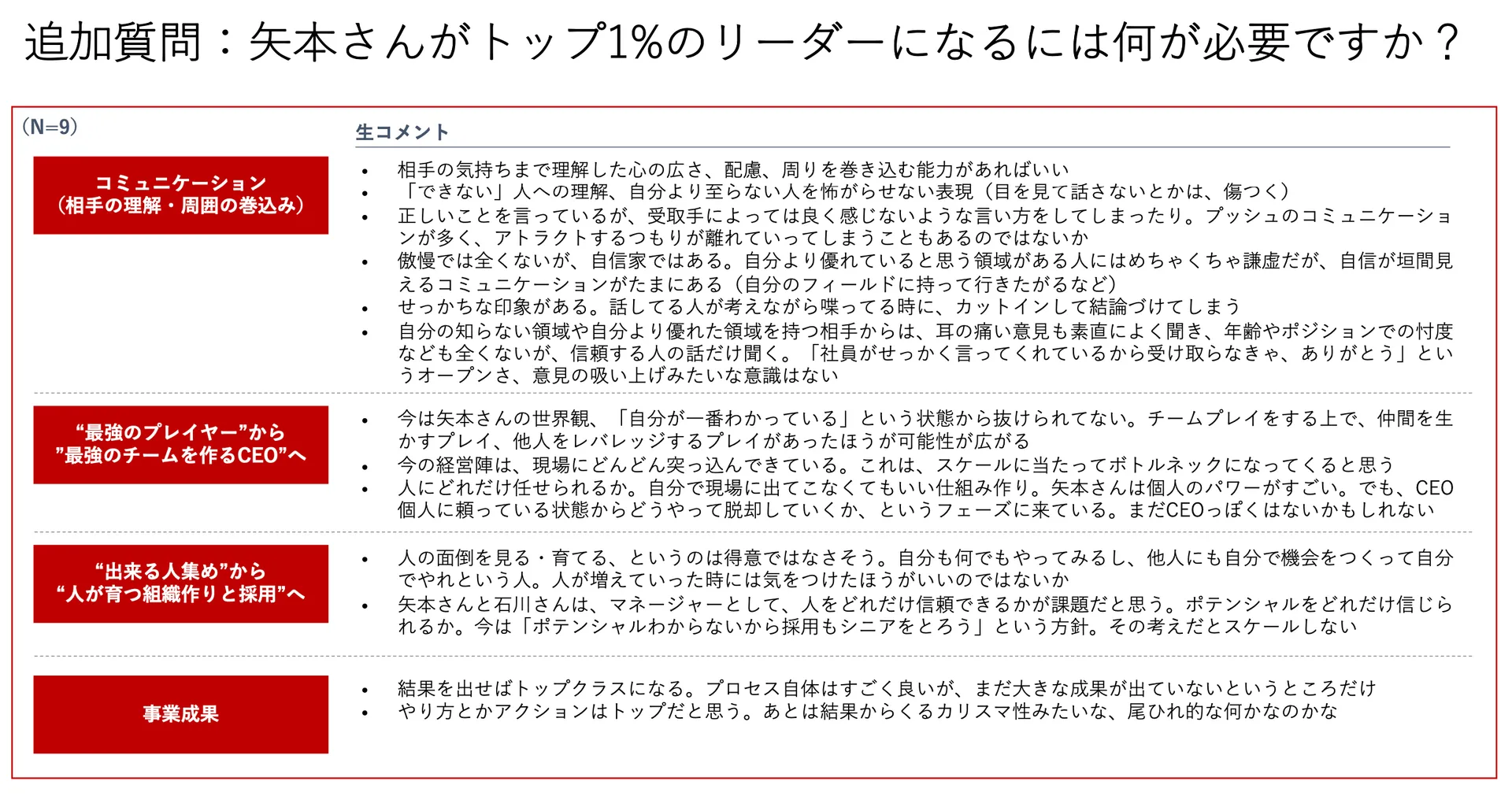
This section had the most feedback I wouldn't normally hear directly — which made it the most valuable part of the whole exercise. Four themes came up: communication, focusing on being an executive, organizational transformation, and business results. No disagreements from me on any of them.
On communication: I want to improve, but it doesn't change easily. I make mistakes at home too. It's not easy for people to point it out either. I'll work at it persistently. First: be less intimidating. Second: express gratitude more explicitly. One instance at a time.
On business results (#4): just work harder. This is less about me alone and more about the team. Business growth is the single best growth opportunity for everyone on the team — not just for me. I say this as someone who spent years with a business that wasn't growing. I know what the alternative feels like.
On items #2 and #3: they're both about organizational scale. I want to develop a clearer picture of how to handle them long-term, then communicate it.
Reflection: thoughts on organizational scaling
Several themes above pointed to how we approach scaling the organization. Here are the three foundational principles I'm working from:
1. "God is in the sequence": What to do in the future is not necessarily what's effective right now. Good sequencing — which organizational design, which hiring, which initiatives, in what order — matters enormously.
2. Organization follows business: Every company exists to accomplish something bigger than any individual could alone. Organizations are designed to increase the throughput of the business. And what "best" looks like varies dramatically depending on the business phase and uncertainty level.
3. Org design is a one-way door: Especially at small scale, each person's behavior has outsized impact on the whole. Japan's strong employment protection regulations mean you can't easily experiment with scaling and shrinking. Mistakes take years to correct. But when you get it right, the benefit to the company is immeasurable. This decision deserves the same weight as capital allocation.
Given these: 10X's current phase is one of extremely high business uncertainty. The most important org design challenge remains "building a team that's strong in uncertainty."
Ideal state now:
- 10 people solving the 20 most important problems
- Major direction changes possible top-down
- Antifragile to those changes; able to act fast
- Individuals' creativity running in parallel
In reality, a company as small as 10X needs strict risk control around big decisions. If we fail, the company dies and causes real harm. The founders and executives bear responsibility for the outcomes of uncertainty — I don't think it's right to separate top management from the business at this stage.
If I'm being honest, this comes down to my own limited capacity.
There are founders who raise enormous capital, generate cash flow, hire broadly, invest heavily in communication, and create buffers for failure. That's not the path I'm choosing — or can choose. That's probably a large part of why I can't yet reach "top 1% executive." I know I need to work toward it, and the proof will be in results.
Ideal state at scale:
- 100 people solving 100 problems bottom-up
- Each of 100 people expressing their specific strength
- Systems that amplify each person 1.1x
- High-uncertainty new business and low-uncertainty scaling business coexisting
This is nearly the opposite of our current "individual power, single breakthrough" model.
For 10X, transitioning from the current sharp organization to the next phase while preserving what's good — that's a major future challenge. What makes it possible is one thing: strong enough business progress that the CEO has the resources and organizational slack to make the transition. Get the sequence right.
What's next
Everything we need to strengthen the organization and prepare it for scale came through clearly in this evaluation.
Specifically, three actions:
- Clarify and communicate the intent and context behind our mission (document it)
- Define "what inclusivity means and what the issues are," and create conditions where it coexists with autonomy (document it + design initiatives)
- Build a team that compensates for what I personally lack (recruiting)
These three are areas I've consciously sacrificed in service of maximizing business execution. But I'm now clearly designating them as high-priority issues — breaking them down, assessing priority, and acting.
Going forward, I'll run this evaluation twice a year and continue publishing the results.
One more reflection: to truly monitor organizational health, we need a more comprehensive survey that can be tracked over time. We immediately decided to have DCM run a startup-founder-customized survey semi-annually going forward. I'll publish those results too.

Comments
Share your thoughts or questions. Comments are published after approval.
Write a comment